

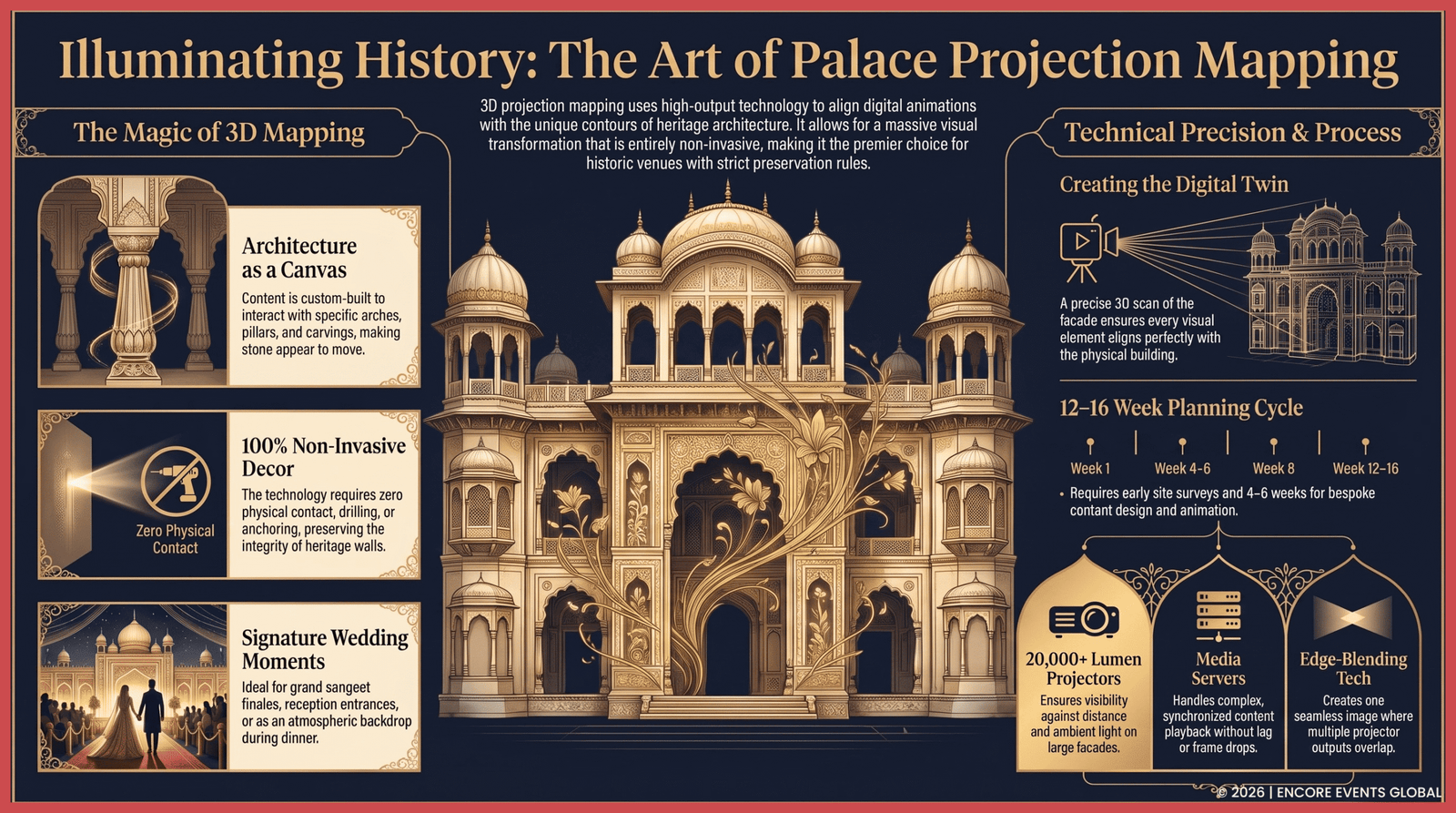
There is a moment at certain weddings that guests remember for years afterward — the instant a centuries-old palace facade suddenly comes alive with colour, motion, and light, telling a visual story that seems to grow directly out of the stone itself. That moment is not decor in the traditional sense. It is 3D projection mapping, and it has become one of the most requested technical elements for heritage venue weddings in India.
What makes projection mapping particularly suited to heritage architecture is precisely what makes it technically demanding: every palace facade is unique, irregular, and structurally irreplaceable. Getting it right requires a combination of artistic vision and precise technical execution that very few production teams have genuinely mastered.
At Encore Events Global, projection mapping on heritage walls is one of our most distinctive technical capabilities. This guide explains how it actually works and what to know before you commit to it for your celebration.
What Is 3D Projection Mapping?
3D projection mapping is a technology that uses calibrated projectors to display moving visual content precisely onto an irregular surface — in this case, a palace facade with its arches, jharokhas, columns, and carved details — so that the imagery appears to interact with and emerge from the actual architecture, rather than simply being displayed flat on top of it.
Unlike a standard projection onto a flat screen, mapped content is custom-built to match the exact contours and dimensions of the specific wall it will be projected onto. A door appears to open in stone that has no door. Floral patterns appear to grow organically along carved pillars. Light seems to pour from windows that are otherwise dark. The effect, when executed well, is genuinely transformative.
Why Heritage Palace Walls Make Such Powerful Canvases
Heritage architecture offers something a modern flat LED screen simply cannot: texture, history, and irregularity. The carved jharokhas, arched doorways, domed chhatris, and ornamental stonework of a Rajasthani palace create natural depth and visual interest that projection content can play with directly — light tracing along an existing carved border, colour pooling inside an actual archway, imagery that respects and enhances the architecture rather than competing with it.
This is also precisely why heritage mapping is harder than mapping onto a purpose-built modern surface. Every palace wall is different. There is no template. Each project starts from a detailed survey of the specific facade being used.
How the Process Actually Works
Step 1: 3D Surface Survey
A precise 3D scan or detailed photographic and measured survey of the target facade is conducted on site. This captures every architectural detail — depth of carvings, exact dimensions of arches and columns, surface texture variations — that the content needs to align with.
Step 2: Digital Model Creation
The survey data is used to build an accurate 3D digital model of the facade in specialised mapping software. This digital twin is what content designers actually work on, allowing them to preview exactly how content will appear on the real wall before a single projector is set up.
Step 3: Content Design and Animation
Custom visual content is designed and animated specifically for the digital model of the facade — not generic stock projection content, but bespoke imagery built around the couple’s story, the wedding theme, and the specific architectural features of the chosen wall.
Step 4: On-Site Calibration
Projectors are positioned and precisely calibrated on site, with the content fine-tuned in real conditions to account for any discrepancies between the digital model and the physical wall, ambient light conditions, and viewing angles from the actual guest seating area.
Step 5: Technical Rehearsal
A full rehearsal synchronising the projection content with any accompanying music, narration, or live elements (such as the couple’s entrance) ensures the final show runs flawlessly on the actual event day.
Equipment Requirements for Palace-Scale Mapping
| Component | Why It Matters |
|---|---|
| High-Lumen Projectors | A large palace facade requires multiple high-output projectors (often 20,000+ lumens each) to remain visible against ambient light and distance |
| Media Servers | Dedicated playback systems that handle the complex, synchronised content across multiple projectors without lag or frame drops |
| Edge-Blending Technology | Ensures seamless transitions where multiple projector outputs overlap on a large or wide facade |
| Stable Rigging Platforms | Projectors must be mounted on completely stable platforms positioned at the correct throw distance, calculated during the site survey |
| Synchronised Audio System | Music and narration must be precisely timed to the visual content for the full emotional impact of the show |
Content Design: What Makes a Mapping Show Land
The technology is only half the equation. The content itself determines whether a projection mapping show is genuinely memorable or simply a technical demonstration. The most effective wedding projection shows tend to share a few characteristics:
- Architectural respect: Content that works with the existing carvings, arches, and textures of the facade rather than ignoring them creates a far more immersive effect than generic imagery that could be projected onto any flat surface.
- A clear narrative arc: The strongest shows tell a brief, emotionally resonant story — often drawing on the couple’s journey, family heritage, or the cultural significance of the venue itself — rather than simply cycling through visual effects.
- Restraint: Counter-intuitively, the most impressive mapping shows often use moments of darkness and stillness as effectively as bursts of colour and motion. Knowing when to pull back is as important as knowing when to go big.
- Perfect timing with live moments: The most powerful use of projection mapping is often synchronised precisely with a live moment — the couple’s entrance, the unveiling of the mandap, the first dance — rather than running as a standalone show.
Preserving Heritage Integrity During Installation
One of the most important and least understood aspects of projection mapping is that, done correctly, it requires zero physical alteration to the heritage structure itself. Unlike physical decor installations that may need anchoring points or fixtures, projection mapping is entirely non-invasive — the projectors and rigging are positioned on the ground or on independent scaffolding structures well away from the palace wall, never touching the heritage surface at all.
This makes projection mapping one of the few large-scale visual transformations possible at heritage properties with strict preservation requirements, where physical decor anchoring, drilling, or attachment to walls would be prohibited or heavily restricted by the property’s conservation guidelines.
Best Wedding Moments for Projection Mapping
- Sangeet finale: A culminating visual show after the performances, transitioning the mood from celebration to wonder as the evening winds down
- Reception entrance: Timed precisely with the couple’s grand entrance, with the facade visually “”awakening”” as they step into the venue
- Storytelling sequences: A dedicated segment of the evening where the couple’s story or family heritage is told through mapped visuals before transitioning into the next ceremony or performance
- Ambient backdrop: Subtler, slower-moving mapped content used as an atmospheric backdrop throughout dinner or cocktail hours, without demanding full attention
Planning Timeline and What It Requires From You
Given the custom content creation and on-site survey requirements, projection mapping needs significantly more lead time than standard decor or lighting. A realistic timeline includes a site survey 8–10 weeks before the event, content design and animation taking 4–6 weeks depending on complexity, and on-site installation and rehearsal in the final week before the wedding.
From the family’s side, the main input required is creative direction — sharing the couple’s story, family heritage details, and the overall mood the show should evoke — early enough for the content design team to build something genuinely personal rather than generic.
How Encore Events Global Delivers Projection Mapping
At Encore Events Global, projection mapping projects begin with a dedicated site survey by our Technical Director, ensuring the digital model used for content design is an exact match for the real facade. Our in-house fabrication and design studio in Andheri West develops bespoke content tailored to each couple’s story and the specific architectural character of the chosen venue.
We manage the full technical execution — projector rigging, media server configuration, edge-blending calibration, and audio synchronisation — with a complete technical rehearsal before the wedding day, ensuring the show runs exactly as designed when it matters most.
If you are considering a heritage palace for your wedding and want to explore how projection mapping could transform the venue, connect with our team for an initial creative consultation.
Frequently Asked Questions
Does 3D projection mapping damage heritage palace walls?
No. Projection mapping is entirely non-invasive. Projectors and rigging are positioned independently of the heritage structure, with no drilling, anchoring, or physical contact with the wall itself, making it suitable for properties with strict conservation requirements.
How far in advance do we need to plan projection mapping for our wedding?
A realistic timeline requires 12–16 weeks total, including an on-site survey 8–10 weeks before the event, several weeks for custom content design and animation, and final on-site installation and rehearsal in the week before the wedding.
Can projection mapping work on any palace or heritage building?
Most facades with sufficient flat or gently curved surface area and adequate space for projector placement at the correct throw distance can support mapping. A site survey is required to confirm technical feasibility for any specific venue.
What is the difference between projection mapping and a regular projector show?
A regular projection displays flat content onto a surface without accounting for its shape. Projection mapping custom-builds content specifically aligned to the exact contours, depth, and architectural features of the target surface, creating the illusion that the visuals are part of the structure itself.
How does Encore Events Global create custom projection mapping content?
Encore conducts a detailed 3D survey of the target facade, builds an accurate digital model, and designs bespoke animated content around the couple’s story and the venue’s architectural character through its in-house design studio, followed by precise on-site calibration and a full technical rehearsal.
Conclusion
A heritage palace already carries centuries of history in its stone. Projection mapping does not replace that history — it gives it a new, temporary voice for one extraordinary evening, transforming a blank wall into a moving, breathing part of the celebration without altering a single brick.
For couples and families seeking a wedding moment that genuinely surprises guests who have seen every other kind of decor, projection mapping remains one of the few technologies that still manages to feel like magic, even when you understand exactly how it works.
Talk to Encore Events Global about bringing projection mapping to your heritage venue wedding.