

At a luxury wedding, the food and beverage experience is not a supporting element. It is a primary one. Guests who forget the exact colour of the floral centrepieces will remember clearly whether the biryani was extraordinary or merely adequate, whether the bar service was attentive or chaotic, and whether someone noticed their dietary preference without being asked twice.
Food and beverage at the luxury end of the Indian wedding market has evolved far beyond a buffet of standard dishes. It now involves deliberate menu engineering, theatrical live cooking stations, curated beverage programmes, and a service standard that would hold its own at a five-star hotel — executed in venues that are sometimes heritage palaces, sometimes open-air beaches, sometimes both simultaneously.
At Encore Events Global, F&B planning is an integral part of our wedding production process, coordinated with the same rigour as the technical and logistics elements. This guide covers how menu engineering and white-glove bar service actually work at the luxury level.
What Menu Engineering Actually Means
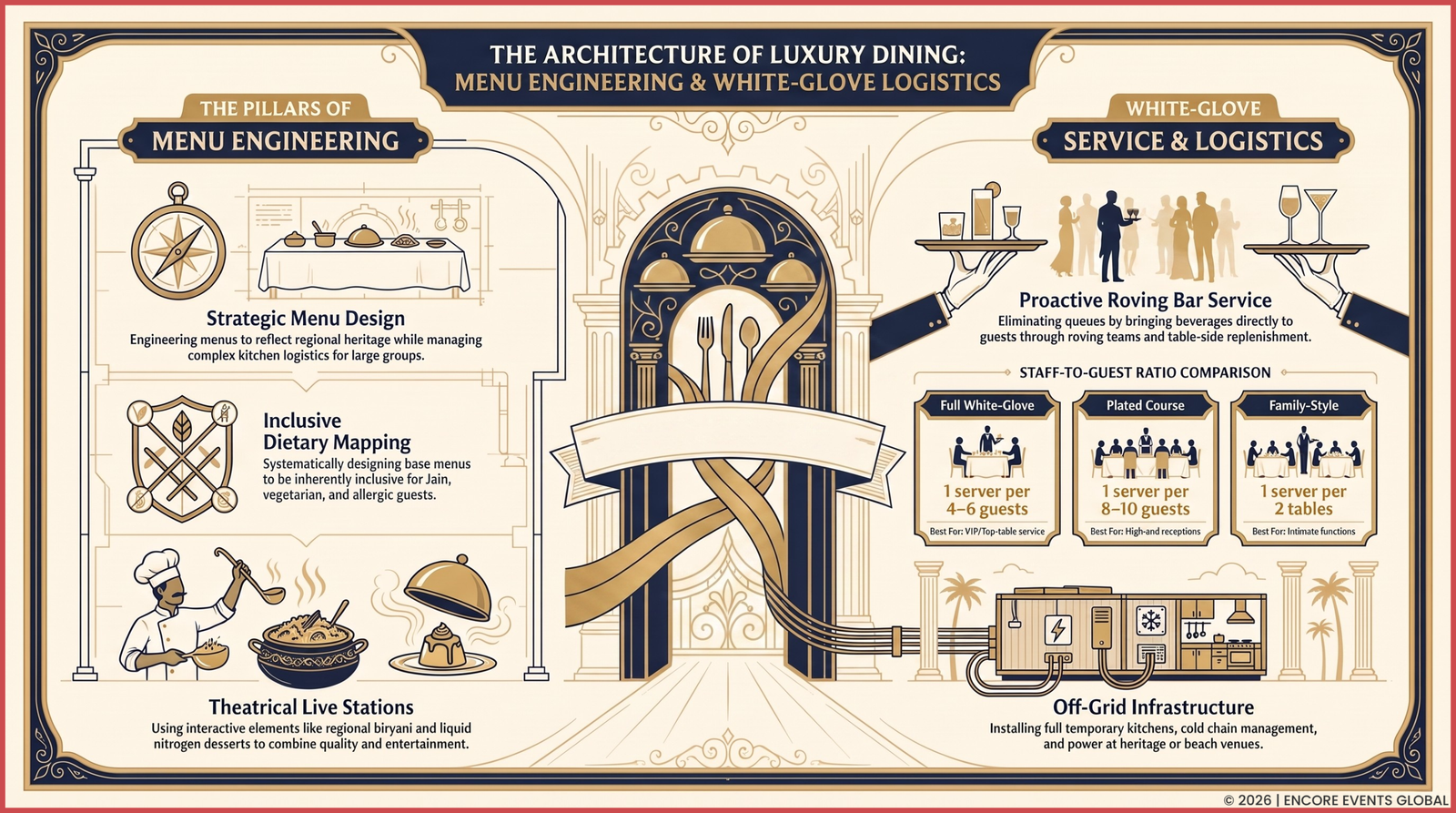
Menu engineering, borrowed from the restaurant industry, refers to the deliberate design of a menu to achieve specific guest experience outcomes — in a wedding context, that means creating a food programme that reflects the couple’s identity and regional heritage, accommodates every guest’s dietary requirements without compromise, creates distinct food experiences across different functions, and manages kitchen logistics effectively for large group service.
The engineering element is what distinguishes a thoughtfully designed wedding menu from one that is simply a long list of dishes. Decisions about flow (which courses at which point in the evening), temperature management (what can be held without quality degradation, what must be cooked to order), service format (plated vs. buffet vs. live station), and sensory variety (texture, temperature, spice level progression across a meal) are all part of the menu engineering process.
Dietary Mapping for Large, Diverse Guest Lists
A 400-guest Indian wedding will typically include strict vegetarians, Jain guests (no root vegetables, no onion, no garlic), guests observing religious dietary restrictions, guests with allergies or medical dietary requirements, and international guests with their own dietary expectations. Managing this complexity requires a dietary mapping process that begins well before the menu is finalised.
Effective dietary mapping involves collecting dietary requirements systematically through the guest communication process, categorising requirements by type and frequency, designing the base menu to be inherently inclusive rather than building special dietary options as afterthoughts, and briefing kitchen and service staff with individual guest dietary notes where required.
A Jain guest who receives a clearly labelled, full-flavoured meal prepared with proper Jain protocols remembers it. A Jain guest who receives a sad plate of boiled vegetables when everyone else has a lavish spread also remembers it — for entirely different reasons.
Cuisine Architecture: Structuring the Menu Experience
Luxury wedding menus are increasingly structured as multi-act culinary experiences rather than a single large meal. A typical multi-function wedding might include:
- Mehendi / Haldi: Light, bright daytime food — regional chaats, fruit stations, pressed juice bars, and regional sweet specialities. The food language should feel celebratory and informal.
- Cocktail reception: Passed canapés, small plate stations, and artisanal mocktail or cocktail service. The emphasis is on social eating — food that facilitates conversation rather than demanding concentration.
- Sangeet dinner: A more abundant, festive spread — often anchored by one or two showpiece dishes or live stations — with the energy and variety to sustain a long evening.
- Wedding day lunch or dinner: The centrepiece meal, designed with the greatest care. Regional heritage, family recipes, and a curated beverage pairing deserve consideration here above all other functions.
- Post-ceremony breakfast or brunch: For multi-day weddings, a late-morning spread that transitions guests gently out of the celebrations while maintaining the hospitality register of the event.
Live Cooking Stations: Theatre and Quality Combined
Live cooking stations are the most significant F&B trend at Indian luxury weddings over the past five years, and for good reason. They solve two problems simultaneously: they guarantee the freshest possible food (cooked to order in front of the guest), and they create an entertaining, interactive element that a static buffet cannot offer.
The most effective live station concepts at luxury weddings include:
- Regional biryani stations: A skilled dum biryani chef with a visible cooking setup, opening dum pots to order, is reliably one of the most photographed and appreciated elements of any wedding dinner.
- Chaat and street food counters: Elevated interpretations of beloved street food — golgappas with premium fillings, truffle-laden dahi puri, artisanal pav bhaji — bring familiarity and joy to a luxury setting.
- International carving and pasta stations: For weddings with international guests or a contemporary cuisine brief, live pasta, risotto, or carving stations provide culinary variety and visual interest.
- Dessert experiences: Live jalebi frying, nitrogen ice cream, chaat-style dessert counters, and architectural mithai displays replace the standard dessert table with interactive finishing moments.
The logistics of live stations require planning beyond the culinary: adequate kitchen infrastructure and power connections near the station, staff-to-station ratios that prevent queuing, and enough physical spacing between stations to allow guest flow without bottlenecks.
Service Standards: From Buffet to White-Glove
The service format chosen for a wedding dinner communicates as much as the food itself. The spectrum from self-service buffet to full white-glove plated service carries significant implications for guest experience, staffing requirements, and kitchen infrastructure.
| Service Format | Best For | Staff Ratio |
|---|---|---|
| Assisted Buffet | Large groups (300+) where variety and volume are priorities | 1 server per 2 buffet stations |
| Family-Style Service | Intimate functions (up to 100 guests) where communal dining atmosphere is desired | 1 server per 2 tables |
| Plated Course Service | High-end reception dinners and leadership dinners where controlled pacing and presentation matter | 1 server per 8–10 guests |
| Full White-Glove | VIP tables, top-table service, or intimate dinners for 40 guests or fewer | 1 server per 4–6 guests |
Designing the Bar Programme
The bar programme at a luxury event is a designed experience, not simply a list of available drinks. A well-designed bar programme has a clear concept (regional spirits, heritage cocktails, a specific flavour story), a curated selection that reflects the overall event aesthetic, and service standards that match the quality of the beverages being served.
For Indian destination weddings, the bar programme typically needs to account for a mix of guests who drink alcohol and those who do not, which means the mocktail and non-alcoholic beverage programme deserves the same creative attention as the alcoholic bar — not an afterthought of juice and soda.
Premium mocktail stations — with house-made syrups, fresh fruit infusions, botanical garnishes, and skilled bartenders who treat the mocktail with the same care as a cocktail — consistently generate the most positive F&B feedback from guests at luxury Indian weddings.
White-Glove Bar Service: What It Involves
White-glove bar service at a luxury event means beverages are brought to guests rather than guests queuing at a bar. This requires a fundamentally different operational setup:
- Roving service teams: Trained bartenders and service staff circulate continuously through the event space with pre-prepared drinks on trays, as well as taking individual orders and delivering them promptly to the guest’s seat or standing position.
- Table-side service: For seated dinners, beverages are poured and replenished at the table rather than by the guest visiting a bar station. This requires a significantly higher staff-to-guest ratio and pre-positioned drink service equipment at or near each table cluster.
- Bar-back logistics: A well-organised back-of-house bar setup is critical for white-glove service — ice management, glassware inventory, spirit organisation, and garnish preparation all need to support a service team that cannot pause to sort through a disorganised bar mid-service.
- Signature welcome drinks: White-glove service typically begins at arrival with a signature welcome drink delivered to every guest individually as they enter the venue — creating an immediate impression of personalised hospitality.
F&B Logistics at Outdoor and Heritage Venues
Executing luxury F&B at a destination other than a hotel kitchen presents specific logistical challenges that require dedicated planning:
- Temporary kitchen infrastructure: Many heritage palace courtyards and beach venues require a complete temporary kitchen to be installed, including gas connections, food-safe worktop space, adequate refrigeration, and generator-powered cooking equipment.
- Cold chain management: In warm climates, maintaining food safety for cold preparations across a multi-hour event requires dedicated cold storage, temperature monitoring, and strict service timing protocols.
- Water supply and waste management: Adequate potable water for cooking and service, as well as waste disposal infrastructure compliant with the venue’s requirements, must be planned and installed independently at many heritage and outdoor sites.
- Pest management: Outdoor evening events in India require proactive pest management planning, particularly for sweet food stations and open fruit displays.
Sustainability in Luxury Event F&B
Sustainable F&B practices are increasingly requested by corporate clients and younger HNI families who are conscious of their event’s environmental footprint. Practical sustainability measures that do not compromise quality include seasonal and locally sourced menu ingredients that reduce supply chain distance, compostable or reusable serviceware for informal functions, food waste reduction through precise guest count management and kitchen portioning protocols, and post-event food donation arrangements for surplus prepared food to local NGOs or community kitchens.
These measures also provide meaningful content for corporate CSR reports and personal social media narratives, which adds value beyond the environmental benefit itself.
How Encore Events Global Coordinates F&B at Luxury Events
At Encore Events Global, F&B coordination is integrated into our overall event production planning rather than managed as a separate vendor relationship. We work with vetted catering partners whose quality standards we have directly verified, brief them on the production context (venue infrastructure, timing constraints, service format), and manage the F&B component alongside all other production elements under a single accountability structure.
For venues without hotel kitchen infrastructure, our logistics team coordinates temporary kitchen installation, power supply, cold chain management, and waste logistics as part of the overall venue production plan.
Our Single-Window Billing model covers catering alongside all other vendor invoices, simplifying the reconciliation process for families managing a complex multi-vendor wedding budget.
If you are planning a luxury wedding or corporate gala and want F&B planning that matches the standard of the rest of your event, connect with our team for a consultation.
Frequently Asked Questions
What is menu engineering in the context of a luxury wedding?
Menu engineering is the deliberate design of a wedding’s food programme to achieve specific guest experience outcomes — managing dietary diversity, creating culinary variety across functions, controlling kitchen logistics for large-group service, and ensuring food quality is maintained throughout a multi-hour event.
How should Jain and vegetarian dietary requirements be handled at large weddings?
Dietary requirements should be systematically collected through guest communication, and the base menu should be designed to be inherently inclusive rather than treating special dietary needs as afterthoughts. Jain guests should receive full, flavourful meals prepared with proper Jain protocols, not stripped-down versions of standard dishes.
What is white-glove bar service and when is it appropriate?
White-glove bar service means beverages are brought to guests by roving service staff and poured at the table, rather than guests queuing at a bar. It is appropriate for seated dinners, VIP functions, and events where the service experience is as important as the beverage quality. It requires a significantly higher staff-to-guest ratio than standard bar service.
What are the F&B logistics challenges at heritage palace or outdoor beach venues?
Heritage and outdoor venues often require complete temporary kitchen infrastructure, cold chain management in warm climates, independent water supply and waste management, and pest management planning — none of which are needed when using a hotel’s existing kitchen facilities.
How does Encore Events Global integrate F&B into wedding production?
Encore coordinates F&B as an integrated component of overall event production, working with vetted catering partners, managing temporary kitchen infrastructure at non-hotel venues, and covering all catering costs under the Single-Window Billing model for simplified financial management.
Conclusion
Food and beverage at a luxury wedding is not a checkbox on the planning list. It is a multi-dimensional hospitality experience that spans every function, every guest preference, and every moment from the welcome drink to the final mithai. When it is designed and executed with the same deliberateness as the decor and entertainment, it elevates the entire event. When it is treated as an afterthought, it becomes the thing guests remember for the wrong reasons.
Menu engineering, thoughtful dietary inclusion, live cooking theatre, and white-glove bar service are not luxuries at the luxury level of Indian wedding production. They are the standard the occasion deserves.
Talk to Encore Events Global about F&B planning for your next luxury wedding or corporate event.