

Udaipur does not need much help being beautiful. The city of lakes, with its white marble palaces rising from the water and the Aravalli hills framing every view, arrives with centuries of visual language already in place. The challenge of designing a wedding here is not creating beauty from nothing — it is designing something that belongs.
The weddings that succeed in Udaipur are the ones where the decor, the colour palette, the florals, and the lighting feel like a natural extension of the architecture rather than an imposition on it. The ones that feel off are almost always the result of applying a generic luxury wedding aesthetic to a setting that has a very specific character of its own.
At Encore Events Global, we have produced weddings across Udaipur’s most iconic heritage properties — from lakeside palace courtyards to hilltop fort venues. This guide distils what actually works when designing a royal heritage wedding aesthetic in one of India’s most demanding visual environments.
Understanding Udaipur’s Visual DNA
Before any design decision is made, the aesthetic language of the specific venue needs to be understood deeply. Udaipur’s heritage properties are not interchangeable. Taj Lake Palace floats on water with a Mughal-influenced architecture of pure white marble and intricate lattice screens. Udaivilas follows a contemporary take on traditional Mewar palace design with domed pavilions and still pools. The City Palace is vast, layered, and ornate, with centuries of different architectural periods visible simultaneously.
Each of these settings has a different dominant material palette, a different relationship with natural light, and a different spatial character. A design concept developed for one cannot simply be transplanted to another. The first step in any Udaipur wedding design brief is a thorough site-specific study of the venue itself — its predominant colours, its light conditions at different times of day, its key architectural features, and the spaces where each ceremony will unfold.
Colour Palettes That Complement Heritage Marble
Udaipur’s dominant architectural material is white and cream marble, often with inlaid pietra dura work in soft greens, terracottas, and muted golds. This creates a specific starting point for colour decisions that many wedding designers underestimate.
Palettes That Work
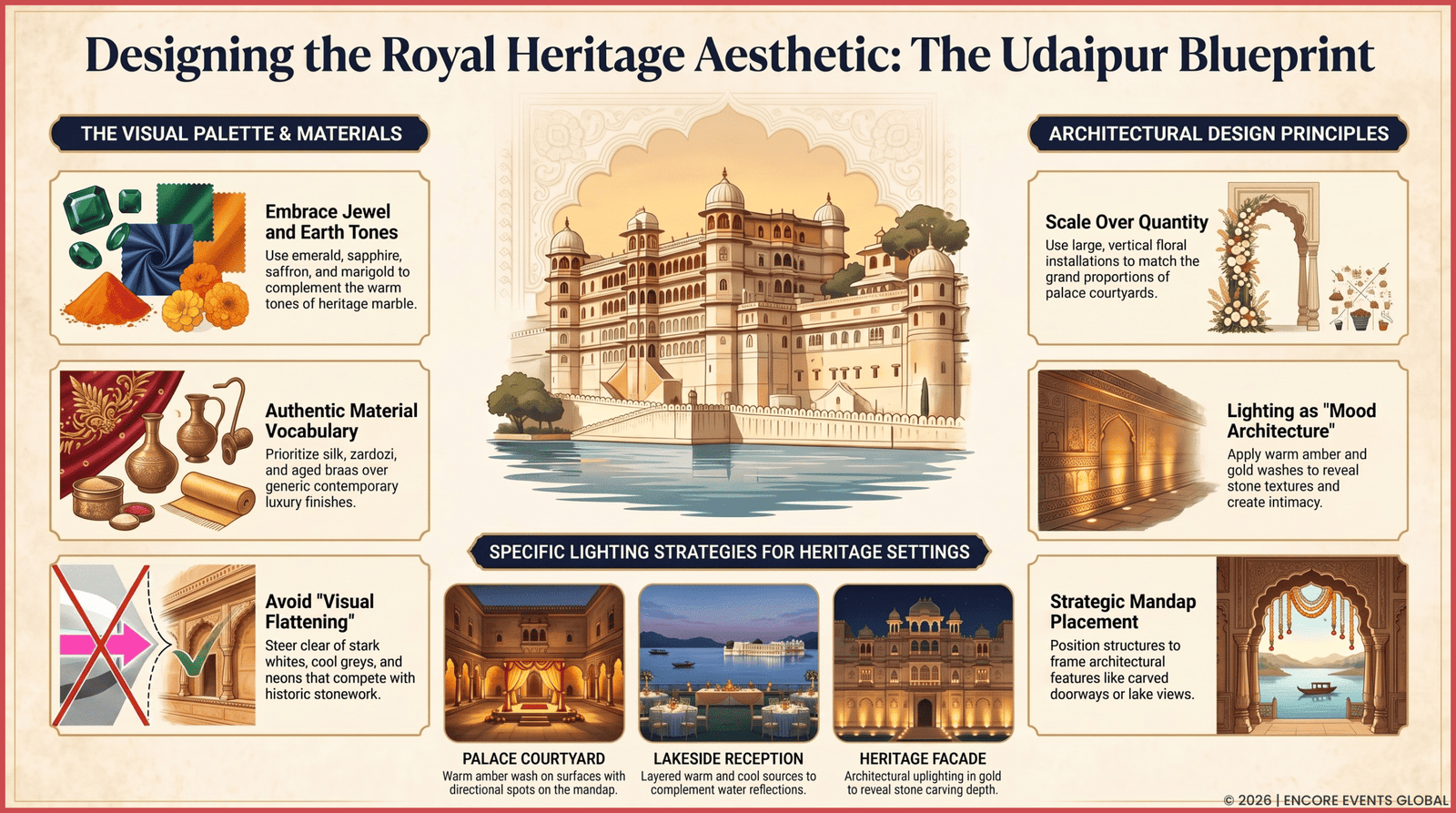
- Deep jewel tones: Emerald, sapphire, deep burgundy, and forest green read as regal against white marble without overwhelming it. These colours have the weight and saturation to hold their own in a large architectural space.
- Warm terracotta and saffron: These tones echo the natural colours of Rajasthan’s landscape and the warm light of a Udaipur evening, creating an organic visual continuity between the venue and the design.
- Marigold and gold: The traditional Rajasthani wedding palette works in Udaipur for good reason — the warmth of marigold and aged gold harmonises naturally with the warm-toned marble of most heritage properties.
- Soft blush and ivory: For daytime ceremonies and mehendi functions, softer palettes can work beautifully in the filtered light of a shaded palace courtyard, though they require careful floral and fabric selection to avoid feeling washed out.
Palettes to Approach with Caution
- Stark whites and cool greys: These tend to compete with or flatten the warm tones of heritage marble rather than complementing them.
- Neon and highly saturated contemporary tones: High-contrast modern colours can look jarring against centuries-old stone and carved marble in ways that photographs rarely capture but in-person always reveal.
Floral Design: Working With the Architecture
Floral design at a heritage venue is fundamentally different from floral design at a purpose-built hotel ballroom, and the difference comes down to one principle: the architecture is already the statement. The florals need to complement, frame, and enhance — not compete.
Scale and Proportion
Heritage palace spaces are typically large, high-ceilinged, and architecturally complex. Floral arrangements that would feel lavish in a standard banquet hall can look sparse or lost in a palace courtyard. Scale is everything — large, cascading floral installations that follow the vertical lines of carved columns or archways tend to work far better than a greater number of smaller, tabletop-level arrangements.
Flower Selection
Traditional Indian wedding florals — marigold, jasmine, tuberose, mogra, and roses in jewel tones — have a particular affinity with Rajasthani heritage settings. Their textures, scents, and colour relationships with the marble and stonework feel authentic rather than imported. Contemporary tropical or European flowers can work in curated applications but require careful integration to avoid looking incongruous.
Ceiling and Overhead Installations
One of the most powerful uses of florals at a heritage venue is in overhead canopy installations that create an intimate, defined space within a large open courtyard — drawing the eye downward to the ceremony space without obscuring the architectural backdrop above. Floral chandeliers, suspended garland grids, and canopy structures woven from marigold and rose work particularly well at lakeside and courtyard venues where the sky forms part of the setting.
Mandap Design at Heritage Venues
The mandap is the visual centrepiece of every wedding ceremony, and at a heritage venue it carries an additional design responsibility: it needs to read as intentional and beautiful against an already extraordinary architectural backdrop, rather than simply blocking it.
The most successful mandap designs at Udaipur heritage venues tend toward restraint in structure and richness in material. A simple geometric frame in aged brass or carved wood, draped in rich silk and living florals, allows the palace architecture behind it to remain visible and to enhance rather than compete. Elaborate multi-tier structures with heavy fabricated elements can visually clutter a setting that derives its power from clarity and proportion.
Positioning matters as much as design. A mandap placed to frame a specific architectural feature — a carved doorway, an arched window with a lake view, a pillar colonnade — creates a layered visual composition that a mandap placed arbitrarily in the centre of a space cannot achieve.
Lighting Philosophy for Palace Settings
Lighting at a heritage wedding venue is not about illumination — it is about mood architecture. The goal is to use light to define the emotional register of each moment and space, while respecting and enhancing the existing character of the architecture.
| Setting / Moment | Recommended Lighting Approach |
|---|---|
| Palace courtyard ceremony | Warm amber wash on architectural surfaces, directional spots on the mandap, candle and diyas at ground level for intimacy |
| Lakeside reception | Layered warm and cool sources to complement the water reflection, uplighting on perimeter architecture, festoon or fairy light canopies for intimate zones |
| Sangeet performance | Stage-specific theatrical lighting, dynamic colour shifts for performance moments, audience wash maintained at warm ambient levels |
| Mehendi / daytime function | Natural light enhancement rather than override, sheer fabric diffusers where direct sun is harsh, lanterns and coloured glass for decorative warmth |
| Heritage facade at night | Architectural uplighting in warm gold or amber to reveal stone texture and carving depth, projection mapping where appropriate |
One principle applies across all of these: avoid cool white or blue-toned light on heritage stone. Warm amber and gold consistently render the marble, sandstone, and carved surfaces of Udaipur’s palaces most beautifully, both to the eye and in photography.
Textiles, Fabrics, and Surface Decor
The material vocabulary of a royal Rajasthani aesthetic has centuries of refinement behind it. Leveraging it thoughtfully creates authenticity; ignoring it in favour of generic luxury finishes creates a mismatch.
- Silk and brocade: Rich silks in jewel tones, particularly those with woven or embroidered patterns, carry the visual weight to hold their own against carved marble and create a clear connection to the Rajasthani royal textile tradition.
- Zardozi and mirror work: Embroidered and mirror-worked fabric panels, cushions, and table runners catch candlelight in a way that mass-produced satin or velvet cannot replicate, creating a living, shimmering surface quality that belongs in a palace setting.
- Brass, copper, and aged gold metalwork: Traditional brass diyas, copper water vessels used decoratively, and aged gold accents in lanterns and candle holders complement the warm marble tones and carry historical resonance that chrome or bright gold does not.
- Block-printed cotton and khadi: For daytime and informal functions, traditional block-printed textiles from Rajasthan’s own craft traditions create an authentic casual elegance that contemporary luxury fabrics often miss in this setting.
Common Design Mistakes at Heritage Venues
- Over-decorating: The single most common mistake at Udaipur venues is adding so much decor that the architecture disappears. The palace is the backdrop — strategic restraint almost always produces a more beautiful result than maximum coverage.
- Generic luxury imports: Crystal chandeliers, white florals, and contemporary European luxury finishes can look beautiful in the right context, but in a 300-year-old palace they often create a visual disconnect that reads as incongruous.
- Ignoring the ceiling: Many heritage courtyards have extraordinary ceiling details — carved stone, painted frescoes, mirror inlay — that are entirely obscured by overhead fabric installations. Light the ceiling rather than cover it.
- Poor mandap placement: Placing the mandap against a blank wall or in the centre of a courtyard without reference to the surrounding architecture misses an opportunity to create a layered, architectural composition.
- Mismatched scale: Tabletop centrepieces scaled for a hotel ballroom look small and lost in a palace hall with 20-foot ceilings. Scale every element to the actual space, not to a generic reference.
Design Approach by Venue Type
| Venue Type | Design Priority | Key Consideration |
|---|---|---|
| Lakeside Palace | Preserve water views; use lighting to connect indoor and outdoor spaces across the waterline | Avoid tall structures that block the lake backdrop from key ceremony positions |
| Courtyard Palace | Use the enclosed courtyard walls as the primary design canvas; overhead canopy to create ceremony intimacy within a large space | Sound management is critical — enclosed courtyards create significant reverb that requires acoustic planning |
| Fort Venue | Maximise the drama of the location with lighting that reveals the structure at night; use the natural elevation and views as part of the experience design | Access logistics for guests, equipment, and catering require dedicated planning given fort locations |
| Garden / Lawn Setting | Create defined ceremony and dining zones within an open space; use temporary structures to provide shade, shelter, and visual anchoring | Wind management for decor and lighting stability, and contingency planning for weather |
How Encore Events Global Approaches Udaipur Wedding Design
At Encore Events Global, our Udaipur wedding design process starts with a dedicated site study — not a generic venue briefing, but a detailed architectural and lighting analysis of the specific spaces being used for each ceremony and function. This study informs every design decision that follows, from colour palette selection to mandap positioning to the lighting spec provided to our Technical Director.
Our in-house fabrication unit builds custom mandap structures, furniture, and decor elements to the exact scale and material specification required for heritage venue settings — rather than adapting generic rental inventory. This makes a visible difference in how the final design reads against the architecture.
We also bring the same Technical Director oversight that governs our corporate productions to every Udaipur wedding — ensuring that floral and decor rigging, lighting infrastructure, and any overhead installations are structurally assessed before installation, not assumed to be safe.
If you are planning a royal heritage wedding in Udaipur and want a production partner who approaches the design with the same rigour as the logistics, connect with our team for an initial design consultation.
Frequently Asked Questions
What colours work best for a heritage wedding in Udaipur?
Deep jewel tones — emerald, sapphire, burgundy — and traditional Rajasthani warm tones of saffron, marigold, and terracotta all work beautifully against Udaipur’s white and cream marble. Avoid cool whites and neon tones, which can look jarring against warm heritage stone.
What is the most common design mistake at Udaipur heritage venues?
Over-decorating is the most frequent mistake — adding so much decor that the palace architecture itself disappears. The venue’s beauty is the primary design asset; every element should complement it rather than cover it.
How should lighting be approached at a heritage palace venue?
Warm amber and gold tones consistently work best on heritage marble and sandstone, both to the eye and in photography. The goal is mood architecture — using light to define the emotional register of each space and moment, not simply to illuminate the area.
What makes a mandap design work at a heritage palace venue?
Restraint in structure, richness in material, and thoughtful positioning relative to the surrounding architecture. The best mandap designs allow the palace backdrop to remain visible and to enhance the visual composition, rather than blocking it with heavy fabricated elements.
How does Encore Events Global handle heritage wedding design?
Encore begins with a detailed architectural and lighting study of the specific heritage venue spaces, uses in-house fabrication to build custom elements scaled to heritage settings, and applies Technical Director oversight to ensure all rigging, overhead installations, and lighting infrastructure are structurally assessed before installation.
Conclusion
Designing a wedding at a Udaipur heritage palace is an exercise in creative restraint as much as creative ambition. The setting arrives with a visual authority that most event spaces spend enormous effort trying to create. The designer’s job is to understand that authority, work with it, and add elements that feel genuinely earned rather than simply applied.
When the design gets it right — when the floral scale respects the architecture, the colour palette complements the marble, the lighting reveals rather than overwhelms, and the mandap positions itself as part of the venue’s visual logic — the result is a wedding that feels like it could only have happened in this exact place. That specificity is the highest achievement in heritage wedding design.
Talk to Encore Events Global about designing your royal heritage wedding in Udaipur.