

A digital ad gets skipped in three seconds. A billboard gets a glance from a car window. But a hydraulic stage unfolding in a mall atrium, with a crowd already forming around it, gets a phone pulled out of a pocket. That’s the entire argument for phygital brand activations in one sentence — physical spectacle plus digital capture, built for a market where attention is the only currency that still converts.
At Encore Events Global (EEG), this isn’t a buzzword we borrowed from a trend report. It’s how we’ve structured every mall activation, roadshow, and festival zone we’ve built across 50+ Indian cities. This guide breaks down what phygital marketing actually means in practice, why it’s outperforming pure-digital and pure-physical campaigns, and how a brand goes from “we want to be seen” to a measurable, data-backed activation.
Table of Contents
- 1. What “Phygital” Actually Means in Brand Activation
- 2. Why the Attention Economy Killed Passive Advertising
- 3. The Four-Stage Engagement Loop
- 4. Where Phygital Activations Work Best
- 5. Phygital vs. Digital-Only vs. Physical-Only: A Side-by-Side Look
- 6. How EEG Executes a Phygital Activation, Start to Finish
- 7. Measuring ROI: What to Track Beyond Footfall
- 8. Common Pitfalls Brands Should Avoid
- 9. A Realistic Scenario: FMCG Brand, Metro Mall Rollout
- 10. Frequently Asked Questions
- 11. Conclusion
1. What “Phygital” Actually Means in Brand Activation
Phygital is the deliberate fusion of a physical experience with a digital mechanism that captures data or extends reach online. It isn’t a decor trend or a marketing buzzword tacked onto a mall stall — it’s a structural choice about how a brand converts a stranger’s curiosity into a recorded, trackable interaction.
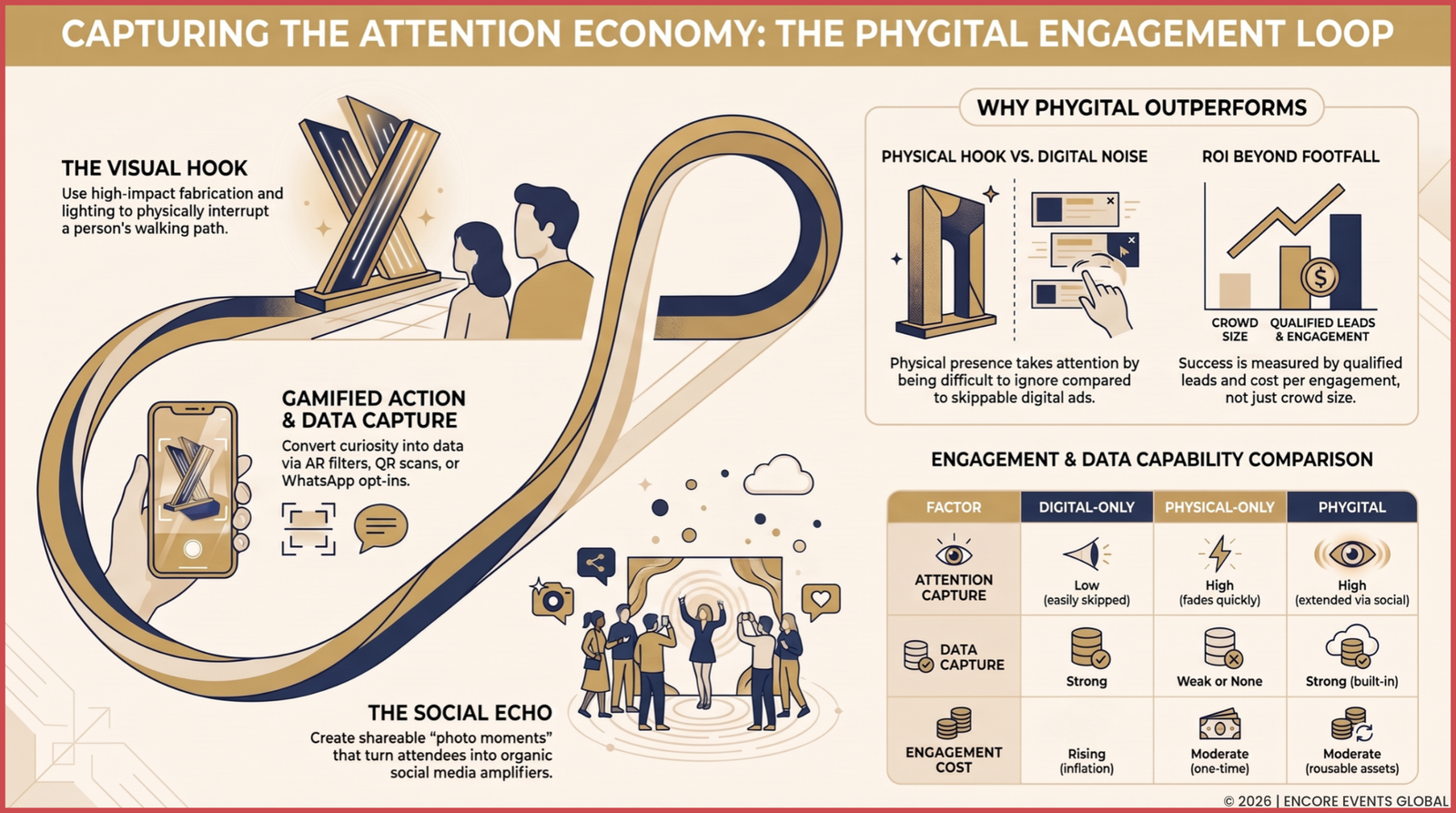
Think of it as two halves of the same transaction. The physical half does the heavy lifting of stopping someone mid-walk: a fabricated installation, an oversized product replica, a hydraulic stage, lighting that draws the eye from thirty feet away. The digital half then converts that attention into something the brand can use later — a WhatsApp opt-in, an AR filter shared on Instagram, a spin-the-wheel entry logged against a phone number.
Neither half works particularly well alone. A stunning installation with no data capture is just decor — memorable for an afternoon, worthless for retargeting. A digital-only campaign, on the other hand, is competing against hundreds of other notifications on the same screen. Phygital activations solve both problems by using the physical moment as the hook and the digital layer as the net.
2. Why the Attention Economy Killed Passive Advertising
Every marketer already knows the numbers are bad for traditional formats. Banner blindness is well documented, skip rates on pre-roll video are high, and outdoor media in dense Indian cities competes with dozens of other hoardings on the same stretch of road. The result is that brands are paying premium rates for impressions that never actually register.
Physical engagement doesn’t have this problem, at least not yet. A well-fabricated activation in a high-footfall mall atrium or a corporate park doesn’t ask for attention — it takes it, because it’s genuinely difficult to ignore something built at scale, lit correctly, and staffed by promoters trained to pull people in. The scarcity of this kind of experience, compared to the flood of digital noise, is exactly why it converts better per rupee spent, provided the execution is fabricated well and placed in the right footfall zone.
3. The Four-Stage Engagement Loop
Every phygital activation EEG builds follows the same underlying mechanic, regardless of the vertical or budget. We call it the Engagement Loop, and skipping any one of these four stages is usually where activations underperform.
Stage 1: The Visual Hook
This is the fabrication doing its job — a structure, prop, or lighting setup dramatic enough to interrupt someone’s walking path. In a mall, this might mean a double-height installation visible from the escalator. On a highway roadshow, it’s a branded hydraulic canter unfolding into a stage in under ten minutes.
Stage 2: Gamified Action
Once someone stops, they need a reason to stay for more than a glance. AR filters, spin wheels, VR trial stations, and simple skill games all serve this purpose — they turn a passive bystander into an active participant, which is also the moment they’re most receptive to a brand message.
Stage 3: Data Capture
This is the step brands most often underinvest in. A QR scan tied to a lead form, a WhatsApp opt-in, or a simple phone-number entry for a reward converts a fleeting interaction into a permanent, retargetable asset. Without this step, the activation generates goodwill but no pipeline.
Stage 4: Social Echo
The final stage extends the activation’s life beyond the physical footprint. Branded photo moments, shareable AR filters, and on-ground content creators turn a few hours of mall footfall into days of organic social reach, as attendees post their own experience without being asked to.
4. Where Phygital Activations Work Best
Not every format suits every brand goal. Here’s how the major activation environments differ in what they’re actually good for.
| Format | Best For | Typical Duration |
|---|---|---|
| Mall Atriums | High-impact brand recall, premium/lifestyle products | 3–7 days |
| Roadshows / Hydraulic Canters | Multi-city reach, Tier 2/3 penetration, FMCG sampling | 1–2 days per stop |
| Corporate Parks | B2B targeting, fintech/SaaS lead generation | 1–3 days |
| Festival Zones | High-volume sampling, mass-market FMCG | Event-length (1–5 days) |
5. Phygital vs. Digital-Only vs. Physical-Only: A Side-by-Side Look
| Factor | Digital-Only | Physical-Only | Phygital |
|---|---|---|---|
| Attention capture | Low, easily skipped | High, but fades post-event | High and extended via social echo |
| Data capture | Strong (cookies, forms) | Weak or none by default | Strong, built into the loop |
| Cost per genuine engagement | Rising steadily (auction inflation) | Moderate, one-time build cost | Moderate, with reusable modular decor |
6. How EEG Executes a Phygital Activation, Start to Finish
Every activation we run passes through the same disciplined pipeline, drawn from our broader Brand Activations practice:
- Footfall and heat-map analysis — identifying which malls, corporate parks, or highway routes actually deliver the target demographic, rather than guessing based on city size alone.
- Concept and 3D visualization — building the visual hook digitally first, so the client signs off before a single panel is cut.
- Off-site fabrication — roughly 70% of any structure is built in our Andheri workshop, which keeps on-site dust and assembly time to a minimum.
- Technical integration — AR filters, QR data capture, and any interactive tech are tested independently before the activation goes live.
- Promoter training and staffing — the people running the Engagement Loop on the ground matter as much as the structure itself.
- Live execution with a Technical Director on-site — overseeing power load, structural safety, and real-time troubleshooting.
- Post-event reporting — footfall numbers, leads captured, and social reach consolidated into a single report for the marketing team.
7. Measuring ROI: What to Track Beyond Footfall
Footfall is the easiest number to report and the least useful one on its own. A crowd standing near an installation doesn’t tell you anything about intent. What actually matters:
- Qualified leads captured — how many people completed the data-capture step, not just walked past.
- Cost per lead — total activation spend divided by qualified leads, compared against your digital acquisition cost for the same audience.
- Dwell time — how long the average visitor engaged, which correlates strongly with recall in post-event surveys.
- Social impressions generated organically — content posted by attendees, not paid amplification.
- Conversion from the captured database — did the leads actually turn into sales or sign-ups within 30–60 days?
We build post-event sustainability and performance reports as standard practice, which also happens to help brands that need to justify activation spend to CSR or ESG-linked budgets.
8. Common Pitfalls Brands Should Avoid
A few mistakes show up repeatedly across the industry, and most are avoidable with better planning:
- Skipping the digital layer entirely. A beautifully fabricated stall with no QR code or app tie-in is a missed opportunity to build a retargetable database.
- Choosing footfall over fit. The busiest mall in a city isn’t automatically the right one if the shopper demographic doesn’t match your product.
- Under-training promoters. The Engagement Loop breaks down fast if ground staff can’t explain the gamified action clearly within a few seconds.
- Ignoring structural and electrical safety. Hydraulic stages and heavy installations need certified load calculations and proper earthing — cutting corners here is a liability risk, not just a technical one.
- No plan for the data after collection. Leads captured on-ground need a follow-up sequence within days, not weeks, or the intent decays.
9. A Realistic Scenario: FMCG Brand, Metro Mall Rollout
Consider a personal care brand launching a new product line across five metro malls over a single weekend. The visual hook is a branded arch with an oversized product installation visible from two floors up. Shoppers who stop are invited to try an AR filter that “applies” the product virtually and generates a shareable video. Completing the filter unlocks a sample, which requires a phone number and consent for future offers — the data-capture step.
By Monday, the brand isn’t just holding footfall estimates. It has a database of verified, product-curious leads segmented by mall and city, a set of user-generated videos circulating organically, and dwell-time data showing which mall location performed best — informing where the next phase of rollout should go. That’s the difference between an activation that photographs well and one that actually moves a business metric.
10. Frequently Asked Questions
What is a phygital brand activation, in simple terms?
It’s a marketing activation that combines a physical, attention-grabbing experience — an installation, roadshow, or stall — with a digital mechanism like an AR filter or QR-based data capture, so the brand gets both engagement and a trackable database from the same event.
How much does a phygital activation typically cost in India?
Costs vary widely based on fabrication complexity, city tier, and duration — a single-mall activation with basic AR integration sits at a different budget than a multi-city roadshow with hydraulic canters. The honest answer is that it depends on footfall targets and structure scale, which is why a footfall and heat-map analysis is the first step, not the fabrication quote.
Do phygital activations work for B2B brands, not just FMCG?
Yes — corporate park activations built around lead-capture kiosks, product demo booths, and gamified skill challenges are common for fintech and SaaS brands targeting office footfall in business districts.
How is data captured during an activation kept compliant?
Consent-based opt-ins (explicit checkbox or verbal consent recorded digitally) at the point of data capture, rather than passive collection, is the standard approach — brands should confirm their specific consent language with legal counsel based on current data protection requirements.
What’s the difference between a brand activation and a brand activation agency’s “phygital” offering?
Any agency can build a stall. A phygital-focused execution partner builds the Engagement Loop — hook, gamified action, data capture, and social echo — as one connected system rather than four separate vendor line items.
11. Conclusion
Phygital brand activations work because they respect a simple truth about attention: it has to be earned physically before it can be captured digitally. Get the fabrication and footfall targeting right, build the Engagement Loop into the activation from day one, and the data you walk away with is worth more than the impressions any banner campaign could buy for the same spend.
If you’re planning a phygital rollout — whether it’s a single premium mall activation or a nationwide roadshow — get in touch with Encore Events Global to scope footfall, fabrication, and data capture as one integrated plan.