

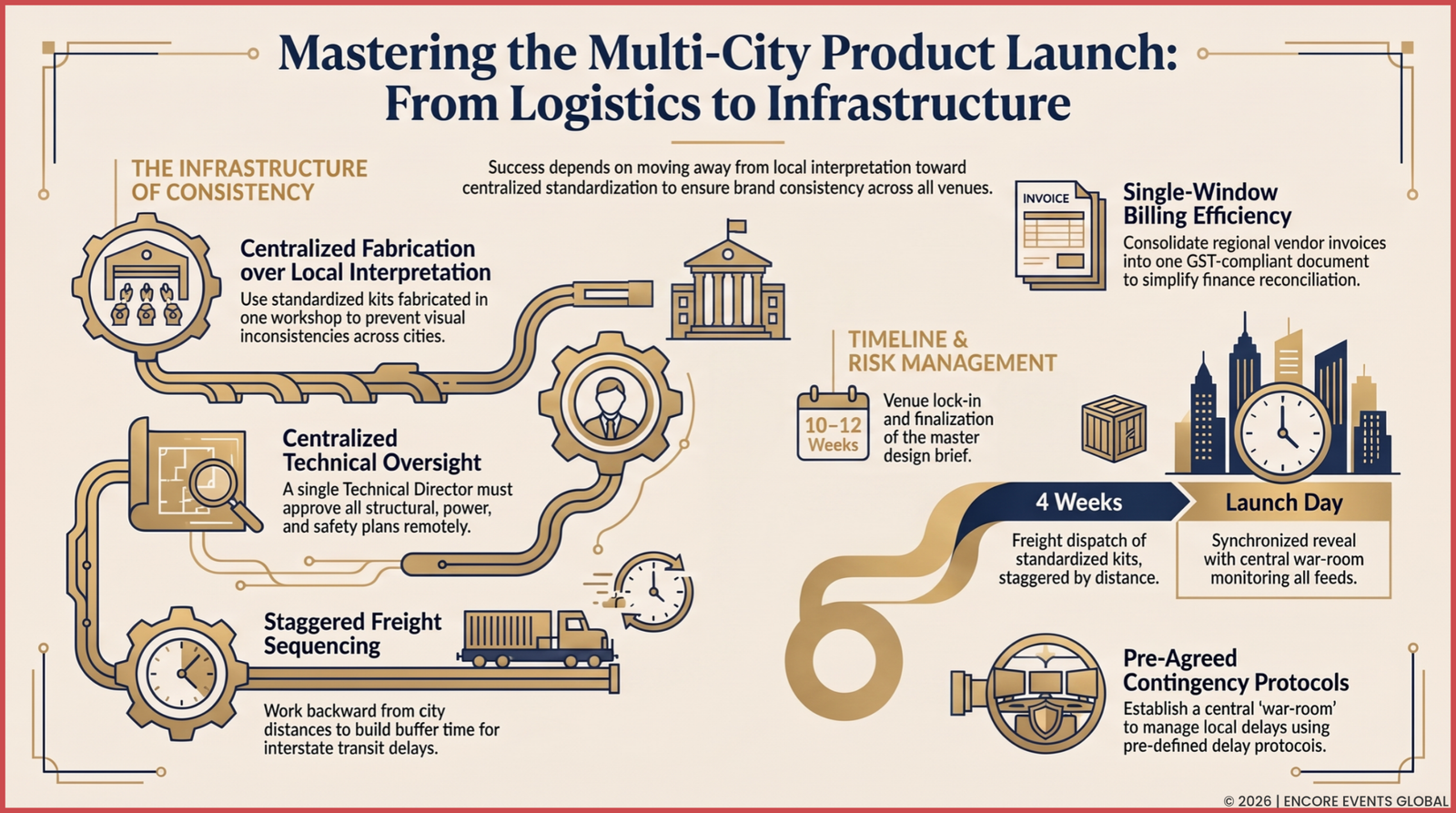
Launching a product in one city is a logistics problem. Launching it in five cities on the same morning is a coordination problem, and the two are not the same skill. A single missed truck, one vendor who didn’t get the final branding files, or a stage that isn’t structurally rated for the local venue can turn a national launch into five inconsistent, embarrassing versions of the same event — happening at the same time, in front of the same national media cycle.
At Encore Events Global (EEG), multi-city rollouts are one of the clearest tests of whether an execution partner actually has the infrastructure it claims to. This guide walks through what a simultaneous multi-city product launch actually requires — standardization, logistics sequencing, technical oversight, and the contingency planning most brands underestimate until launch week.
Table of Contents
- 1. Why Brands Choose Multi-City Simultaneous Launches
- 2. The Core Challenge: Consistency at Distance
- 3. Standardized Kits: The Backbone of Multi-City Execution
- 4. A Realistic Planning Timeline
- 5. Logistics: Moving People, Materials, and Tech Across Cities
- 6. Centralized Technical Oversight vs. Local Vendor Risk
- 7. Single-Window Billing Across Multiple Cities
- 8. Contingency Planning: What Happens When One City Slips
- 9. Simultaneous vs. Sequential Rollouts: Which Should You Choose
- 10. A Realistic Scenario: Five-City Tech Product Launch
- 11. Frequently Asked Questions
- 12. Conclusion
1. Why Brands Choose Multi-City Simultaneous Launches
A simultaneous launch across metros like Mumbai, Delhi, Bengaluru, Hyderabad, and Chennai does something a single-city launch can’t: it generates a nationwide news cycle in a single 24-hour window. Regional press, local influencers, and dealer networks in each city get their own local story instead of a lone flagship event that only benefits one market.
For consumer electronics, automotive, and FMCG brands with an existing dealer network, simultaneous launches also solve a channel-fairness problem. If Bengaluru gets the big reveal and Kolkata gets a press release two weeks later, the Kolkata dealer network reasonably feels like an afterthought. A same-day rollout treats every regional market as a first-tier launch.
2. The Core Challenge: Consistency at Distance
The hard part of multi-city execution isn’t building five stages — it’s building five stages that look, function, and feel identical, run by five different on-ground teams, none of whom can call each other for help mid-event because they’re all managing their own crisis at the same time.
Brand consistency breaks down in predictable places: slightly different lighting temperatures that make product colors look different on camera, inconsistent signage sizing because a local vendor “adjusted” the design brief, or staggered timing because one city’s venue access was delayed. None of these individually sink a launch, but three or four small inconsistencies across five cities is what turns into a fragmented brand story across regional media.
3. Standardized Kits: The Backbone of Multi-City Execution
The single biggest lever for consistency is refusing to let any city “interpret” the brief. Every element that can be pre-fabricated centrally and shipped as a kit should be:
- Modular stage and backdrop panels fabricated to identical specifications in one workshop, not five different local carpenters working from the same PDF.
- Signage, banners, and branded collateral printed from one master file with locked color values, so a “navy blue” logo doesn’t turn slightly purple in one city’s print run.
- AV and lighting rider — identical equipment specifications and rig plots, adjusted only for venue ceiling height, never for taste.
- Promoter and host scripting — the same core talking points and product demo sequence delivered everywhere, translated for language but not for content.
- QR-based check-in and data capture systems — one centralized backend so lead data from all five cities lands in a single dashboard, not five spreadsheets that need manual merging later.
4. A Realistic Planning Timeline
| Timeline Before Launch | Key Milestone |
|---|---|
| 10–12 weeks | Venue lock-in across all cities, master design brief finalized |
| 6–8 weeks | Fabrication begins centrally; local vendor contracts signed for setup labor only |
| 4 weeks | Freight and dispatch scheduling for kits, staggered by city distance from base |
| 2 weeks | On-site technical dry runs in each city, remote-monitored by a central TD |
| 48 hours | Full assembly complete, final rehearsal, contingency kits on standby |
| Launch day | Synchronized reveal, central war-room monitoring all five feeds |
5. Logistics: Moving People, Materials, and Tech Across Cities
Multi-city rollouts live or die on freight sequencing. Shipping identical kits to five cities isn’t a matter of booking five trucks on the same day — it means working backward from each city’s distance and road/rail conditions so that every kit arrives with buffer time, not exactly on schedule with zero margin for a breakdown or customs delay on interstate shipments of specialized equipment.
EEG’s in-house fleet and warehousing in Mumbai and Delhi function as staging points for exactly this reason — kits can be pre-positioned closer to each launch city days ahead, rather than dispatched from a single origin point under time pressure. For technical equipment or specialized AV gear that needs to move between cities, we build in dedicated transport windows rather than relying on last-mile logistics that weren’t planned around the launch date.
6. Centralized Technical Oversight vs. Local Vendor Risk
Every city needs boots on the ground, but every city should not have full authority to make structural or technical calls independently. This is where a centralized Technical Director model matters: one senior engineer (or a small technical team reporting to one) reviews structural calculations, power load plans, and safety sign-off for all five cities, even if they’re not physically present at each site.
Local vendors execute; the centralized TD approves. This single layer of oversight is what catches a mismatched trussing certification or an underrated generator before it becomes a live problem, rather than after.
7. Single-Window Billing Across Multiple Cities
Five cities usually means five sets of local vendor invoices — venue, transport, labor, catering, security — landing on a finance team’s desk in five different formats over five different weeks. A single-window billing model consolidates this into one GST-compliant invoice from the execution partner, which matters enormously for Input Tax Credit reconciliation and for finance teams who don’t want to chase five regional vendors for corrected paperwork.
8. Contingency Planning: What Happens When One City Slips
Something will go wrong in at least one city — that’s not pessimism, it’s just the base rate across enough moving parts. What separates a well-run multi-city launch from a chaotic one is whether contingency plans exist before launch day, not whether problems occur at all.
- Buffer stock of critical panels and signage pre-positioned at each site, not just at the central warehouse.
- A backup AV and power setup that can be deployed within the hour if primary equipment fails.
- A pre-agreed delay protocol — if one city’s venue access is delayed by two hours, does the reveal proceed without them, or does the whole timeline shift?
- A single point of decision-making during the live event — one war-room, not five site managers independently deciding how to handle their local issue.
9. Simultaneous vs. Sequential Rollouts: Which Should You Choose
| Factor | Simultaneous Launch | Sequential Rollout |
|---|---|---|
| Media impact | High, single national news cycle | Spread thin, risk of local media fatigue |
| Execution risk | Higher, requires central coordination | Lower, lessons carried forward city to city |
| Dealer network fairness | Even, every market treated as first-tier | Uneven, later cities may feel secondary |
| Budget structure | Front-loaded, all cities funded at once | Spread over weeks, easier cash flow |
10. A Realistic Scenario: Five-City Tech Product Launch
Picture a consumer electronics brand launching a new device across Mumbai, Delhi, Bengaluru, Hyderabad, and Pune on the same morning. Identical modular stages, pre-fabricated in the Andheri workshop, are dispatched over a staggered four-day window based on distance, arriving with a two-day buffer in every city. A centralized Technical Director reviews structural sign-off remotely for all five venues the night before.
On launch morning, a war-room monitors live video feeds from all five sites. When Hyderabad’s venue access is delayed by ninety minutes due to a local permit issue, the pre-agreed contingency protocol kicks in — the reveal proceeds in the other four cities on schedule, and Hyderabad’s local team executes a compressed but still-branded version within its adjusted window. Because every element was standardized and the delay was planned for, the final result across all five cities looks and feels identical in every recap video and press photo, regardless of what happened behind the scenes.
11. Frequently Asked Questions
How many cities can realistically launch on the same day?
It depends more on logistics infrastructure than ambition — five to seven cities is a common range for brands with a mature multi-city playbook, though some FMCG rollouts push into ten or more using regional staging warehouses rather than one central dispatch point.
What’s the biggest risk in a simultaneous multi-city launch?
Logistics timing, not creative execution. A structurally sound, well-designed activation that arrives late or incomplete is a bigger failure than a slightly less polished one that’s ready on time.
Should each city have its own local vendor, or one central execution partner?
A hybrid model works best in practice — one central partner owns fabrication standards, technical oversight, and billing, while local, verified vendors handle on-ground labor and venue-specific logistics under that central partner’s supervision.
How far in advance should a multi-city launch be planned?
Ten to twelve weeks is a realistic minimum for five or more cities, primarily to allow enough time for centralized fabrication, freight staggering, and at least one full technical dry run per city before launch day.
Does simultaneous billing across cities complicate GST compliance?
It’s actually simpler with a single-window billing model, since one execution partner issues one consolidated, GST-compliant invoice rather than the finance team reconciling paperwork from five separate regional vendors.
12. Conclusion
A multi-city simultaneous launch is fundamentally a test of an execution partner’s infrastructure, not their creative team. Standardized kits, centralized technical oversight, staggered freight planning, and contingency protocols built in before launch day are what separate a coordinated national moment from five disconnected local events that happen to share a product name.
If your brand is planning a multi-city rollout, talk to Encore Events Global about scoping fabrication, logistics, and technical sign-off as one integrated national plan rather than five separate vendor relationships.