

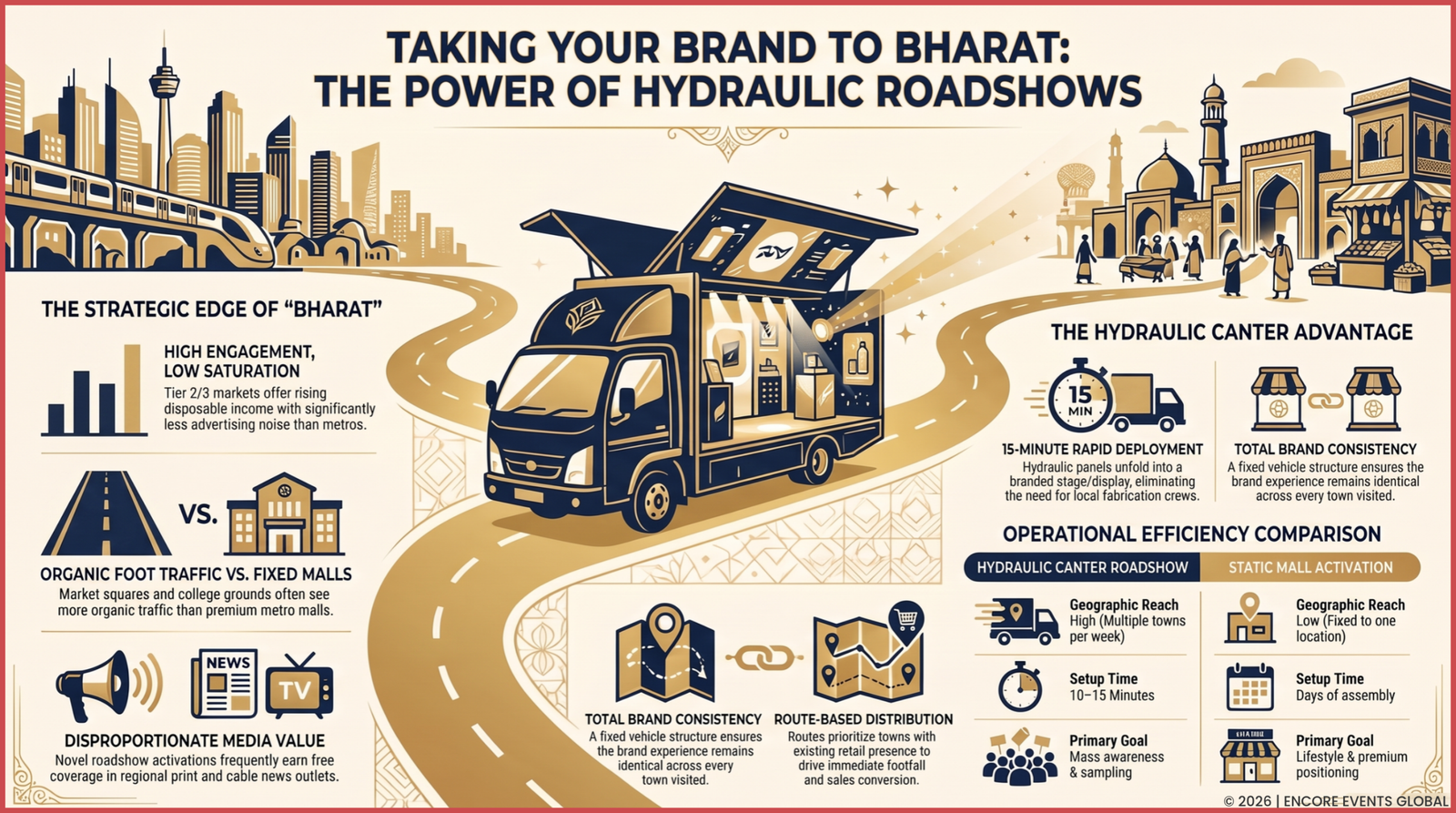
Most brand budgets in India are still built around eight or nine metros. Meanwhile, the country’s next wave of consumer spending is coming from Tier 2 and Tier 3 towns — cities where a shopping mall might not exist yet, but a market square, a college ground, or a highway junction sees more organic foot traffic on a Sunday than most metro malls do on a weekday. This is “Bharat,” as distinct from metro “India,” and it needs a completely different activation format than the one built for Mumbai or Bengaluru.
At Encore Events Global (EEG), Bharat roadshows built around customized hydraulic canter vans are one of our most requested formats for brands trying to reach these markets without the cost of building fixed infrastructure in cities they may only need to visit for a day or two. This guide covers what a hydraulic canter roadshow actually is, why it works specifically for Tier 2/3 markets, and what nationwide consistency requires when your “venue” is a different town every day.
Table of Contents
- 1. What “Bharat” Means for Brand Strategy
- 2. What Is a Hydraulic Canter Van, Exactly
- 3. Why Tier 2/3 Cities Respond Differently Than Metros
- 4. Route Planning: Choosing the Right Towns and Stops
- 5. What a Single Roadshow Day Actually Looks Like
- 6. Nationwide Consistency With a Moving “Venue”
- 7. Hydraulic Canters vs. Static Mall Activations
- 8. Local Considerations: Permissions, Language, and Weather
- 9. Measuring Results Across a Multi-Town Route
- 10. A Realistic Scenario: FMCG Brand, 15-Town Route
- 11. Frequently Asked Questions
- 12. Conclusion
1. What “Bharat” Means for Brand Strategy
“Bharat” has become shorthand in Indian marketing circles for the vast, fast-growing consumer base outside the eight or nine major metros — Tier 2 cities like Indore, Nagpur, and Coimbatore, and Tier 3 towns further down the population curve. These markets often have rising disposable income, strong brand aspiration, and comparatively less advertising saturation than metro consumers who are bombarded daily.
The strategic argument for Bharat-focused activations is straightforward: the cost of reaching an engaged consumer is often lower here than in an oversaturated metro market, but the infrastructure to reach them — malls, corporate parks, premium retail — mostly doesn’t exist yet. Roadshows solve exactly this gap by bringing the activation to the town instead of waiting for the town to build the venue.
2. What Is a Hydraulic Canter Van, Exactly
A hydraulic canter is a modified commercial vehicle — typically built on a Tata or Ashok Leyland canter chassis — fitted with hydraulic panels that unfold into a full branded stage, backdrop, or product display structure. What arrives as a compact, road-legal vehicle can expand into a stage of several times its transport footprint within ten to fifteen minutes, using hydraulic rams rather than manual assembly.
This matters enormously for a multi-town route. There’s no need for a local fabrication crew, no waiting for a truck full of separate panels, and no risk of a piece going missing between stops. The vehicle is the venue, the stage, and the storage unit in one, which is exactly what makes a 15- or 20-town route logistically realistic instead of a fabrication nightmare repeated daily.
3. Why Tier 2/3 Cities Respond Differently Than Metros
Metro consumers have seen mall activations before; a novel spectacle needs to work harder to earn their attention. In a Tier 2 or Tier 3 town, a hydraulic stage unfolding in a market square or college ground is often a genuinely new experience — and that novelty translates into higher engagement rates, longer dwell times, and a crowd that forms organically rather than needing to be pulled in.
Word-of-mouth also moves faster in smaller towns. A well-executed roadshow stop in a Tier 3 town frequently generates local coverage in regional print or cable news that a similar activation in a metro would never get, simply because there’s less competing content for local media to cover that day.
4. Route Planning: Choosing the Right Towns and Stops
Not every Tier 2/3 town is worth a stop, and picking towns by population alone is a common mistake. Route planning should weigh:
- Distribution overlap — towns where the brand already has retail or dealer presence get priority, since the roadshow can drive immediate footfall to existing outlets.
- Road connectivity between stops — a route that looks efficient on a map can lose a full travel day if the highway between two towns is poor.
- Local market days and festivals — timing a stop to coincide with an existing weekly market or local festival multiplies organic footfall without extra promotion spend.
- Permission lead times — some towns require longer municipal or police clearance windows than others, which affects how tightly the route schedule can be packed.
5. What a Single Roadshow Day Actually Looks Like
| Time | Activity |
|---|---|
| 6:00 AM | Convoy arrives at the day’s town, site check with local coordinator |
| 7:00 AM | Hydraulic deployment, sound and power check |
| 9:00 AM – 6:00 PM | Live activation, promoter-led engagement, data capture |
| 6:30 PM | Teardown, hydraulic retraction, footfall and lead data logged |
| 7:00 PM onward | Convoy departs for next town, overnight travel where needed |
6. Nationwide Consistency With a Moving “Venue”
A 15-town route has the same brand consistency challenge as a multi-city launch, compressed into a single moving unit instead of five fixed sites. The advantage of the hydraulic canter format is that the structure itself is fixed and identical at every stop — it can’t be “reinterpreted” by a local vendor because there is no local vendor building it. What does vary from town to town is promoter staffing, local permissions, and crowd management, all of which need a standard operating checklist that travels with the crew rather than being reinvented at each stop.
7. Hydraulic Canters vs. Static Mall Activations
| Factor | Hydraulic Canter Roadshow | Static Mall Activation |
|---|---|---|
| Geographic reach | High, multiple towns per week | Low, fixed to one location |
| Novelty factor in Tier 2/3 | High, often a first-time experience | Not applicable, no malls in most Tier 2/3 towns |
| Setup time per stop | 10–15 minutes, hydraulic deployment | Days, full fabrication and assembly |
| Best for | FMCG sampling, dealer network activation, mass awareness | Premium brand recall, lifestyle positioning |
8. Local Considerations: Permissions, Language, and Weather
A few operational realities separate a smooth Bharat roadshow from a chaotic one:
- Local municipal and police permissions for parking and public assembly need to be secured well ahead of the route, since approval timelines vary significantly by state and town.
- Promoter scripts translated into the regional language, not just Hindi as a default — a Tamil Nadu or Odisha stop needs the local language, not a generic national script.
- Weather contingency for monsoon-season routes, since hydraulic decks and electrical equipment need waterproofing and covered fallback plans in regions where sudden rain is common.
- Fuel and route logistics for the convoy itself, since Tier 2/3 highway infrastructure isn’t always as predictable as national highways connecting major metros.
9. Measuring Results Across a Multi-Town Route
Aggregate footfall across 15 towns is a vanity number unless it’s broken down per stop. What actually informs future route planning:
- Footfall and leads captured per town, to identify which town profiles (population size, market day timing, distribution overlap) perform best.
- Sample-to-purchase conversion where trackable through retail partners in that town.
- Cost per engaged consumer per stop, since fuel and permission costs vary by region and should be weighed against the leads generated.
- Regional media pickup, which is often disproportionately valuable in Tier 2/3 markets relative to its cost.
10. A Realistic Scenario: FMCG Brand, 15-Town Route
Consider a snack food brand running a 15-town route across Madhya Pradesh and Maharashtra over three weeks. Two hydraulic canters run parallel sub-routes to cover more ground, each carrying identical branding, sampling stock, and a QR-based data capture system feeding into one shared dashboard. Route planning prioritized towns with existing distributor presence, timing several stops to coincide with local weekly markets.
By the end of the route, the brand has town-by-town footfall and sampling data, a clear picture of which town profiles converted best into distributor sell-through, and organic regional news coverage in towns that had never hosted a branded activation before. That granular, per-town data is what makes the second route — the following quarter — measurably better targeted than the first.
11. Frequently Asked Questions
What is a hydraulic canter roadshow used for?
It’s primarily used for FMCG product sampling, dealer network activation, and mass-awareness campaigns in Tier 2 and Tier 3 towns where fixed venues like malls aren’t widely available, letting a brand bring a full stage and display setup to a market square, college ground, or highway junction.
How many towns can a single hydraulic canter cover in a route?
It depends on route distance and daily activation hours, but a single vehicle typically covers one town per day, meaning a 15- to 20-town route usually runs three to four weeks, or faster if multiple canters run parallel sub-routes.
Do Bharat roadshows need different content than metro campaigns?
Generally yes — regional language scripting, locally relevant reference points, and pricing or pack-size messaging suited to Tier 2/3 purchasing patterns tend to perform better than a metro campaign simply transplanted without adjustment.
What permissions are needed for a roadshow stop in a small town?
Typically municipal permission for public assembly and parking, and local police clearance for crowd management — requirements and lead times vary by state, so route planning should build in permission buffers rather than assuming uniform timelines across every town.
How is ROI different for Bharat roadshows compared to metro activations?
Cost per engaged consumer is often lower in Tier 2/3 markets due to less advertising saturation, but ROI should be measured per-town rather than in aggregate, since town-level variables like market day timing and distributor overlap significantly affect performance.
12. Conclusion
Bharat roadshows built around hydraulic canter vans solve a specific problem metro-focused strategies can’t: reaching a fast-growing consumer base in towns where fixed venues simply don’t exist yet. The format’s real strength is that the stage travels with the vehicle, keeping every stop structurally identical while route planning, local permissions, and regional-language content do the work of actually connecting with each town.
If your brand is exploring a Tier 2/3 rollout, reach out to Encore Events Global to plan a route that matches distribution overlap, local market timing, and realistic road logistics rather than population numbers alone.