

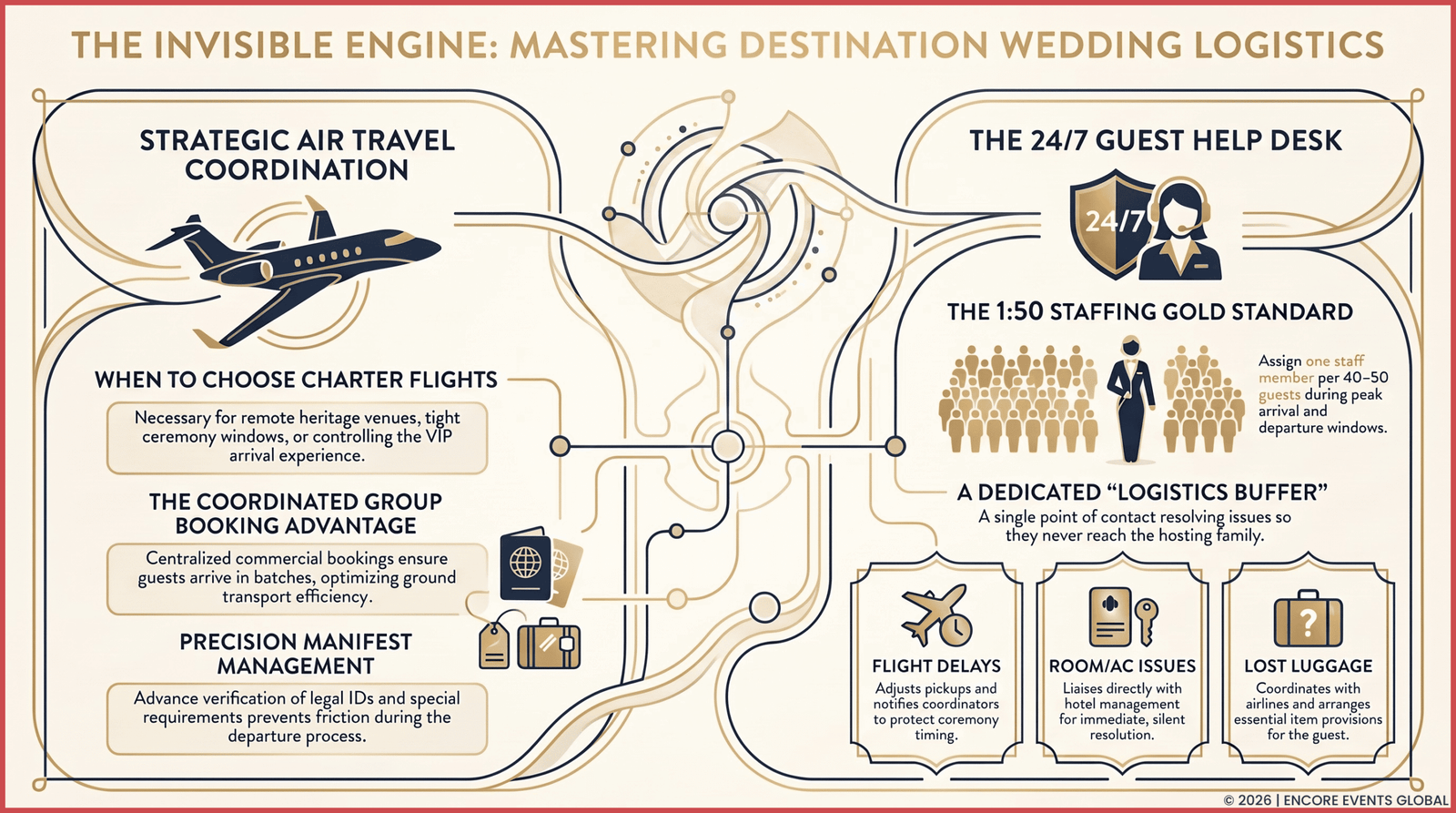
The romance of a destination wedding lives in the photographs — a palace courtyard at sunset, guests dancing barefoot on a beach, a baraat winding through a fort gate. What rarely makes it into the photographs is the logistics machine running quietly behind all of it: the charter flight manifests, the airport pickup schedules, and the help desk fielding two hundred small requests an hour so that none of them ever reach the family.
For weddings drawing guests from multiple cities or countries, this logistics layer is not optional infrastructure — it is the difference between a celebration that feels effortless and one where half the conversation among guests becomes about travel chaos rather than the couple.
At Encore Events Global, charter flight coordination and 24/7 guest support are standard components of our destination wedding logistics service. This guide walks through exactly what that involves.
When Does a Wedding Need a Charter Flight?
Chartering a private aircraft for wedding guests is not as exotic as it once sounds, particularly for weddings hosted at destinations with limited commercial flight connectivity, such as smaller airports near heritage venues in Rajasthan, or where guest groups need to arrive together on a tight schedule that commercial flights cannot accommodate.
Charters become particularly relevant when guests are travelling from a single concentrated location (a large group from one city), when the wedding destination has limited commercial flight frequency, when the family wants to control the exact arrival experience for VIP guests, or when ceremony timing requires guest arrivals within a tight window that commercial schedules cannot reliably support.
How Charter Flight Coordination Actually Works
Aircraft Selection and Sourcing
The right aircraft depends on guest count, the departure and destination airports’ runway capabilities, and budget. Sourcing typically happens through established charter brokers with verified safety records and current fleet availability, rather than going direct to a single operator with limited options.
Manifest Management
Every passenger on a charter flight requires accurate manifest documentation — full legal names matching identification documents, contact details, and any special requirements. Even small manifest errors can cause delays at departure, so this data needs to be collected and verified well in advance.
Airport Coordination at Both Ends
Coordinating ground transport to the departure airport, expedited check-in processes where available, and ground transport from the arrival airport to the wedding venue, ensuring guests experience minimal friction at both ends of the journey.
Contingency Planning
Weather delays, last-minute guest changes, and aircraft maintenance issues all require a contingency plan established before the event — typically including a secondary aircraft option or a fallback commercial flight plan for affected guests.
Group Flight Booking as an Alternative
For many weddings, a full charter is unnecessary, and coordinated group bookings on commercial flights achieve a similar outcome at a lower cost. This involves blocking a guaranteed number of seats on specific flights, often with negotiated group rates, and managing the booking and ticketing process centrally rather than leaving each guest to book individually.
The advantage of centralised group booking, even without a full charter, is consistency: guests arrive in coordinated batches that align with planned airport pickup schedules, rather than arriving in a scattered, unpredictable sequence that strains ground transport logistics.
What a 24/7 Guest Help Desk Actually Does
A dedicated guest help desk is, in practice, a small customer service operation built specifically for the duration of the wedding. It serves as the single point of contact for any guest query, removing the burden from the hosting family and ensuring every guest has immediate access to support, day or night.
Core functions of a well-run help desk include managing transport requests and last-minute changes, resolving room and accommodation issues, providing local information and recommendations, coordinating with medical support for any health concerns, and handling lost luggage or document issues that inevitably arise with large international groups.
Common Guest Requests and How They Get Resolved
| Request Type | Typical Resolution |
|---|---|
| Flight delay or change | Help desk adjusts pickup schedule and notifies relevant ceremony coordinators if arrival affects programme timing |
| Room or AC issue | Help desk liaises directly with hotel management for immediate resolution, without involving the family |
| Lost luggage | Help desk coordinates with the airline and arranges essential item provision until luggage is recovered |
| Dietary clarification | Help desk relays specific requirements directly to catering, confirming with the guest once addressed |
| Medical concern | Help desk coordinates with on-site medical support or local hospital arrangements as needed |
Technology That Supports the Operation
Most professional guest help desks now run on a combination of a dedicated WhatsApp or messaging-based contact line for instant guest access, a centralised ticketing system to track and prioritise requests so nothing falls through the cracks, real-time flight tracking integration to proactively manage pickup schedules, and a shared digital rooming and itinerary list accessible to the entire on-ground team so any staff member can assist any guest without delay.
Staffing the Help Desk: Getting the Ratio Right
Understaffing a guest help desk is one of the most common and costly mistakes in destination wedding planning. A realistic staffing guideline is roughly one help desk staff member for every 40–50 guests during peak arrival and departure windows, with a smaller skeleton team maintaining 24/7 coverage during quieter periods of the event.
This staffing should scale up significantly during the arrival day and departure day, when the volume of transport coordination, room allocation queries, and general orientation questions is highest.
Planning Checklist for Multi-Guest Logistics
- 8–10 weeks out: Finalise guest list and begin collecting travel preferences, passport details (for international guests), and dietary requirements
- 6–8 weeks out: Confirm charter or group flight bookings, issue detailed travel itineraries to all guests
- 3–4 weeks out: Finalise rooming lists, confirm ground transport vendor and vehicle counts, set up the help desk technology and contact channels
- 1 week out: Brief all help desk staff on the complete guest list, special requirements, and event schedule
- Event days: Maintain real-time flight tracking and proactive pickup adjustments, with 24/7 help desk coverage throughout
How Encore Events Global Manages Guest Logistics
At Encore Events Global, guest logistics for destination weddings are managed by the same team and systems we use for large-scale corporate MICE delegations — applying proven group travel coordination discipline to the wedding context.
We manage charter sourcing through established broker relationships, coordinate group commercial bookings when a full charter is not required, and staff a dedicated 24/7 guest help desk scaled appropriately to your guest count, with real-time flight tracking and a centralised digital system accessible to the entire on-ground team.
The result is a guest experience where every traveller, from the first airport pickup to the final departure, feels genuinely looked after — without a single one of those hundred small requests ever reaching the hosting family.
If you are planning a destination wedding with significant out-of-town guest travel, talk to our team about building the right guest logistics plan.
Frequently Asked Questions
When does a destination wedding need a charter flight instead of commercial bookings?
Charters are most valuable when the destination has limited commercial flight connectivity, when a large group is travelling from a single city and needs coordinated arrival timing, or when the family wants full control over the VIP guest arrival experience.
What is the ideal staffing ratio for a wedding guest help desk?
A general guideline is one help desk staff member for every 40–50 guests during peak arrival and departure periods, with reduced but continuous coverage during quieter periods of the event to maintain genuine 24/7 availability.
How early should we start planning guest travel logistics for a destination wedding?
Begin collecting guest travel preferences and key documentation 8–10 weeks before the wedding, with charter or group flight bookings confirmed by 6–8 weeks out to secure availability and competitive rates.
What technology should a wedding guest help desk use?
An effective setup typically includes a dedicated messaging-based contact line, a centralised ticketing system for tracking requests, real-time flight tracking integration, and a shared digital rooming and itinerary list accessible to all on-ground staff.
How does Encore Events Global handle destination wedding guest logistics?
Encore applies the same group travel coordination systems used for corporate MICE delegations to wedding guest logistics, including charter sourcing, group flight booking, and a dedicated 24/7 help desk staffed and scaled according to guest count.
Conclusion
The guests who remember a destination wedding fondly are rarely thinking about the flight coordination or the help desk that quietly resolved their room issue at 11pm. That is precisely the measure of success — when the logistics work so well that they become invisible, leaving guests with nothing to remember except the celebration itself.
Getting there requires treating guest logistics as a genuine operational discipline, not an afterthought bolted onto the decor and catering planning. The families who invest in this layer consistently host the weddings their guests talk about for years — for all the right reasons.
Connect with Encore Events Global to plan seamless guest logistics for your next destination wedding.