

Every MICE program that falls short of expectations has a root cause. Sometimes it is a vendor issue. Occasionally it is a budget problem. But far more often than most companies want to admit, the real culprit is a planning timeline that started too late.
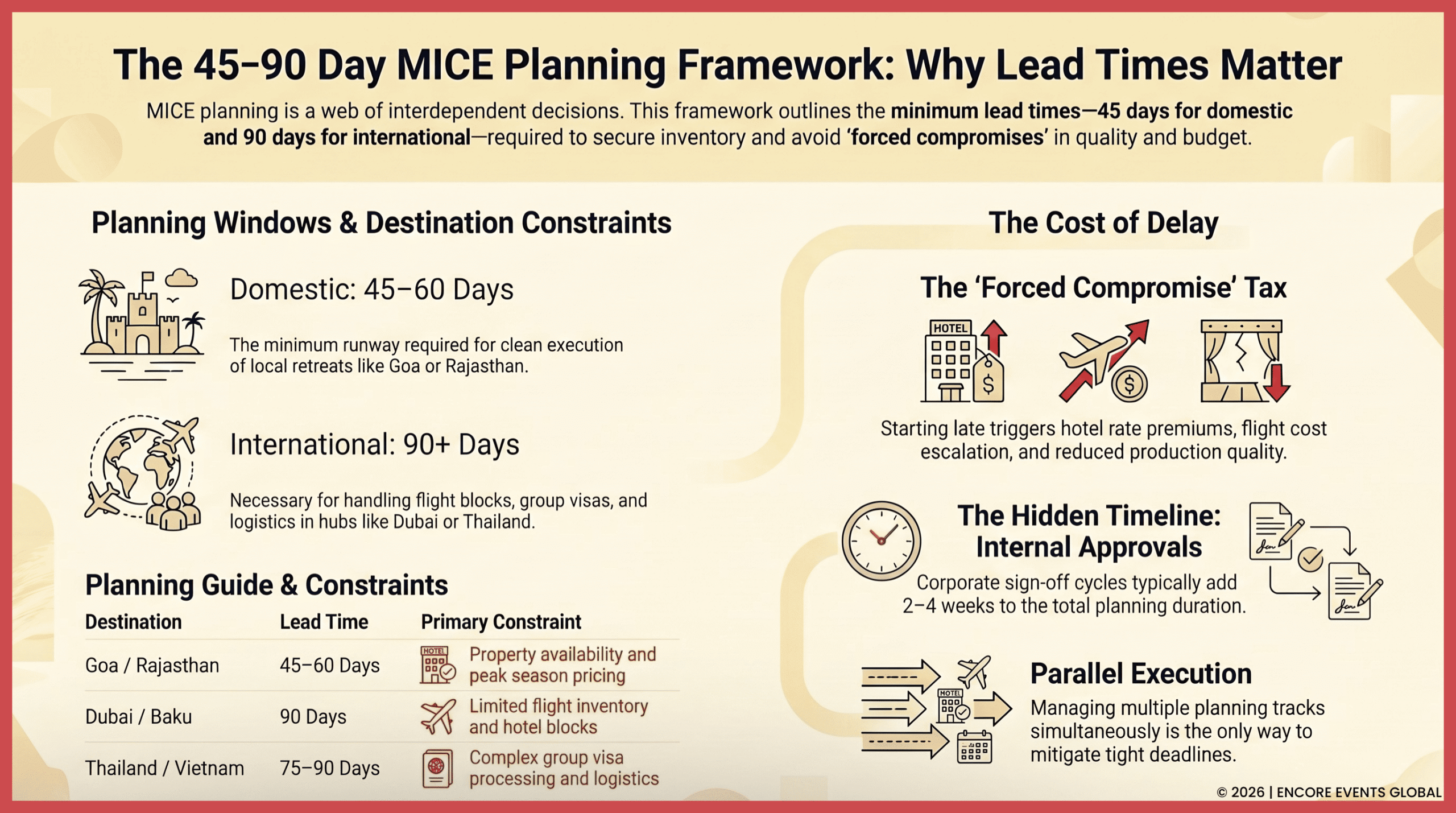
The 45–90 day lead time framework is not an arbitrary industry convention. It reflects the actual logistics of securing hotel room blocks, processing group visas, blocking flight inventory, coordinating production vendors, and managing the dozen other interdependent decisions that need to be made in sequence for a large-group corporate event to come together properly.
At Encore Events Global, we work with companies at every stage of the planning cycle — including those who come to us with six weeks to an international event. This guide explains what the lead time windows mean in practice, and what specifically gets compromised when you start late.
Why Lead Times Matter More Than You Think
Corporate MICE planning is not a linear process. It is a web of interdependent decisions where each one unlocks the next. You cannot confirm the programme until you know the venue. You cannot confirm the venue until hotel rooms are blocked. You cannot block hotel rooms without a confirmed headcount. You cannot confirm headcount without management sign-off. And you cannot get management sign-off without a budget estimate that depends on the venue.
This web of dependencies is why MICE planning timelines compress so badly in practice. Every delay at one node propagates through every downstream decision. The lead time framework exists to give each of these decisions enough runway to be made properly, rather than under pressure.
The consequences of compressed timelines are not just operational. They are financial. Hotels increase room rates when they sense urgency. Airlines charge a premium for last-minute group bookings. Vendors quote higher when they have less preparation time. Starting late is not just inconvenient — it is expensive.
Domestic MICE: The 45–60 Day Window
For domestic MICE events — Goa sales conferences, Rajasthan leadership retreats, Jim Corbett wellness offsites — a minimum of 45–60 days from brief to event is required for a clean execution. Here is what that window actually covers:
Days 45–40: Brief and Shortlisting
Receiving the client brief, shortlisting destinations and properties based on group size, budget, and programme requirements, and issuing initial RFPs to shortlisted hotels. This phase requires a clear brief — vague requirements at this stage cause cascading delays downstream.
Days 40–30: Site Inspection and Venue Confirmation
Physical site inspections of shortlisted properties, followed by rate negotiation and venue confirmation with deposit payment. For peak season domestic destinations — Goa in December, Rajasthan in October–November — preferred properties at fair rates will be unavailable if this phase is delayed beyond day 35.
Days 30–20: Programme Design and Vendor Briefing
Programme agenda finalisation, production brief development, and vendor shortlisting for AV, entertainment, transport, and catering. The production brief must be locked before vendors can provide accurate quotations.
Days 20–10: Delegate Communication and Logistics
Delegate invitations, travel booking, accommodation rooming lists, dietary collection, and pre-event communication. Compressing this phase leads to incomplete delegate information, which creates on-ground chaos.
Days 10–0: Technical Rehearsal and Final Execution
Technical setup, rehearsals, final vendor briefings, and on-ground execution. This phase cannot be compressed without directly compromising production quality.
International MICE: The 90 Day Minimum
For international MICE programs — Dubai incentive trips, Thailand conferences, Baku leadership retreats — 90 days is the minimum viable planning window. For groups above 300 delegates or events during peak travel periods, 120–150 days is strongly recommended.
The additional complexity of international MICE comes from four variables that simply do not exist for domestic events:
Flight Block Bookings
Securing group flight bookings at competitive rates requires a minimum of 60–90 days advance notice for most international routes. Last-minute group bookings — inside 30 days — can cost 40–60% more than planned rates, and preferred departure times are often unavailable entirely.
Group Visa Processing
Even for visa-on-arrival destinations like Dubai, processing group e-visas for 200+ delegates takes 2–3 weeks when you factor in document collection, submission, processing, and error correction. For destinations with embassy-based visa applications — Vietnam, Kazakhstan, some European countries — allow 4–6 weeks minimum.
International Hotel Room Blocking
Premium international properties — particularly in Dubai during October–March or Bangkok during December–February — have high baseline occupancy from leisure and business travel. Securing a room block of 100–300 rooms at a single property or cluster requires 90+ days advance commitment, often with a signed contract and initial deposit.
ATA Carnet and Equipment Logistics
If your event involves specialised production equipment — custom branded stage sets, proprietary AV systems, fabricated display elements — international freight and ATA Carnet processing requires a minimum of 30 days. This window must be built into the overall timeline, not treated as a parallel track.
What Gets Locked In at Each Stage
| Timeline | Domestic MICE | International MICE |
|---|---|---|
| 90 days out | Brief received, destination shortlisting begins | Hotel blocks confirmed, flight group booking initiated |
| 75 days out | Venue confirmed, deposit paid | Visa processing initiated, dietary and passport collection begins |
| 60 days out | Programme locked, vendor briefs issued | Production brief locked, ATA Carnet initiated if required |
| 45 days out | Delegate travel booked, rooming list submitted | Flights confirmed, hotel rooming list submitted |
| 30 days out | All vendors confirmed, production brief finalised | Visas received, delegate travel kits dispatched |
| 14 days out | Technical rehearsal scheduled, final headcount confirmed | Equipment shipped, ground transport confirmed |
| 7 days out | Technical setup begins, on-ground team briefed | Equipment cleared customs, venue walkthrough completed |
What Happens When You Start Late
Starting a MICE program outside the recommended lead time does not simply create inconvenience. It creates a series of forced compromises, each of which costs money, quality, or both:
- Hotel rate premium: Properties that sense urgency — particularly when a company reaches out within 30 days of the required dates — will quote full rack rates with minimal negotiation flexibility. The savings from a 90-day advance booking versus a 30-day booking on a 200-room block can easily run to several lakhs.
- Venue compromise: The preferred property is simply unavailable. You end up at the second or third choice, which may not have the right room configuration, F&B capacity, or production infrastructure for your programme.
- Flight cost escalation: Group airfare quoted at 60+ days often includes negotiated group rates and preferred departure slots. Inside 30 days, you are booking at retail rates in whatever inventory remains.
- Visa rejections and drop-offs: Rushed visa applications have higher error rates. For international MICE, even a small percentage of visa rejections in a group of 200 creates significant operational and morale problems.
- Production quality reduction: Vendors with less preparation time deliver less refined outputs. Custom fabrication, branded production elements, and entertainment bookings all require lead time to execute at the standard a large corporate event demands.
Lead Time by Destination: A Practical Reference
| Destination | Minimum Lead Time | Peak Season | Key Constraint |
|---|---|---|---|
| Goa | 45–60 days | Nov–Jan | Hotel room availability and pricing |
| Rajasthan | 45–60 days | Oct–Mar | Heritage property exclusivity and palace availability |
| Dubai | 90 days | Oct–Mar | Flight block bookings and five-star room inventory |
| Thailand | 75–90 days | Nov–Feb | Hotel room blocks for groups of 200+ |
| Vietnam | 75 days | Dec–Feb | Visa processing and limited premium hotel inventory |
| Baku / Almaty | 90 days | Apr–Jun, Sep–Oct | Limited direct flights and hotel capacity |
The Hidden Timeline: Internal Approvals
One dimension of MICE lead times that rarely appears in planning guides is the internal approval cycle. In most mid-to-large Indian companies, a significant MICE budget requires approval from finance, HR, and often the CXO or board level. That process typically takes 2–4 weeks — which must come before the external planning clock even starts.
This means that if your event is 90 days away and you are still waiting for internal budget approval, your external lead time is already effectively 60 days — which puts an international MICE program under immediate pressure.
The practical solution is to build internal approval processes into the planning timeline explicitly. If your company’s procurement cycle takes 3 weeks, your MICE brief needs to be initiated 90 + 21 days before the event — not 90 days.
Building Your MICE Planning Calendar
A practical approach for companies that run annual or quarterly MICE programs is to establish a rolling planning calendar that maps event dates against brief initiation deadlines. This removes the reactive pressure of last-minute planning and allows for proactive vendor relationships, early-bird hotel rates, and the kind of deliberate programme design that distinguishes memorable events from forgettable ones.
For a company running three to four MICE events per year, the planning calendar should look something like this:
- Q4 events (Oct–Dec): Brief initiated by end of July at the latest
- Q1 events (Jan–Mar): Brief initiated by end of October at the latest
- Q2 events (Apr–Jun): Brief initiated by end of January at the latest
- Q3 events (Jul–Sep): Brief initiated by end of April at the latest
Mapping these deadlines into your annual HR and procurement calendar — alongside the internal approval cycle — is the single most effective operational change a company can make to improve its MICE program quality and cost efficiency simultaneously.
How Encore Events Global Manages the Timeline
At Encore Events Global, timeline management is central to how we operate. Every MICE project is assigned a dedicated project manager who owns a milestone-based planning timeline from brief to execution, with clear accountability at each stage.
Our in-house logistics team manages the interdependent tracks — hotel blocking, flight coordination, visa processing, vendor briefing, and production planning — in parallel rather than sequentially, which compresses the effective planning cycle without cutting corners.
For clients who come to us with compressed timelines, we are transparent about what is and is not achievable. We will not overpromise and underdeliver. What we will do is use our verified network of 500+ partners to access options and rates that are not available to companies going direct, which often partially offsets the cost premium of a shorter lead time.
If you are planning a MICE event for the second half of 2026 and have not started yet, the conversation needs to happen now. Reach out to our team for a no-obligation brief review and timeline assessment.
Frequently Asked Questions
What is the minimum lead time for a domestic MICE event in India?
A minimum of 45–60 days is recommended for domestic MICE events in destinations like Goa or Rajasthan. During peak season (October–March), 60–75 days is strongly advised to secure preferred properties at competitive rates.
Why do international MICE events need 90 days of planning?
International MICE programs require 90 days to manage flight block bookings, group visa processing, international hotel room blocking, ATA Carnet documentation for equipment, and the multi-currency logistics that do not exist for domestic events. Each of these tracks has its own minimum processing time that cannot be compressed.
What happens if we start planning a MICE event with less than 45 days lead time?
Starting inside 45 days for a domestic event typically results in higher hotel rates, compromised venue choices, and rushed production planning. For international events, a less-than-60-day lead time creates significant risk of visa processing failures, full-price flight bookings, and limited hotel room availability.
How does Encore Events Global handle compressed timelines?
Encore uses its verified network of 500+ partners to access options not available through direct channels, and manages planning tracks in parallel rather than sequentially to compress the effective planning cycle. We are transparent about what is achievable within a given lead time and will not overpromise.
How should internal approval timelines factor into MICE planning?
Internal approval cycles — typically 2–4 weeks in mid-to-large Indian companies — must be added to the external lead time requirement. A 90-day external lead time becomes a 111–118 day total timeline when internal approvals are factored in correctly.
Conclusion
The 45–90 day lead time framework is not a preference — it is a reflection of the actual logistics required to execute a corporate MICE program at the standard a professional event demands. Every day inside that window that is lost to delayed decisions, internal approvals, or compressed planning is a day that costs money, quality, or both.
The companies that consistently run the best MICE programs are not the ones with the biggest budgets. They are the ones that start the conversation early enough to make good decisions rather than fast ones.
Start the conversation with Encore Events Global early — and we will make sure your timeline works for you, not against you.