

Somewhere along the way, the sangeet stopped being a family singing function and became a full-blown live show. Choreographed dance sequences performed by family members rehearsed for weeks, professional dancers, a live band or DJ, sometimes a celebrity performance — the modern Indian sangeet has the production value of a concert. Most families simply have not updated their sound system expectations to match.
This mismatch shows up in a very specific, very avoidable way: a sangeet with stunning choreography and genuine emotional weight, undercut by audio that sounds thin, distorted at the edges of the room, or simply too quiet for the energy the performances deserve. The single most common reason this happens is using a standard hotel PA system for a performance that genuinely needs concert-grade line array audio.
At Encore Events Global, we treat sangeet sound design with the same technical rigour as a live concert production, because that is functionally what it is. Here is what that actually means.
Why a Sangeet Is Not Like Other Wedding Functions
Most wedding ceremonies are fundamentally about ritual and atmosphere — ambient music, a priest’s recitation, soft background sound. A sangeet is structurally different. It is a sequence of performances, often with live vocals, choreographed group dance numbers set to high-energy music, occasional live instrumentalists, and an audience expected to actively respond, cheer, and dance themselves by the end of the night.
This performance format demands the same audio infrastructure as a concert: clear, even coverage across the entire audience area, sufficient headroom to handle dynamic range from quiet vocal moments to high-energy dance drops, and a sound system robust enough to run for several hours without distortion or failure.
What Is Line Array Audio?
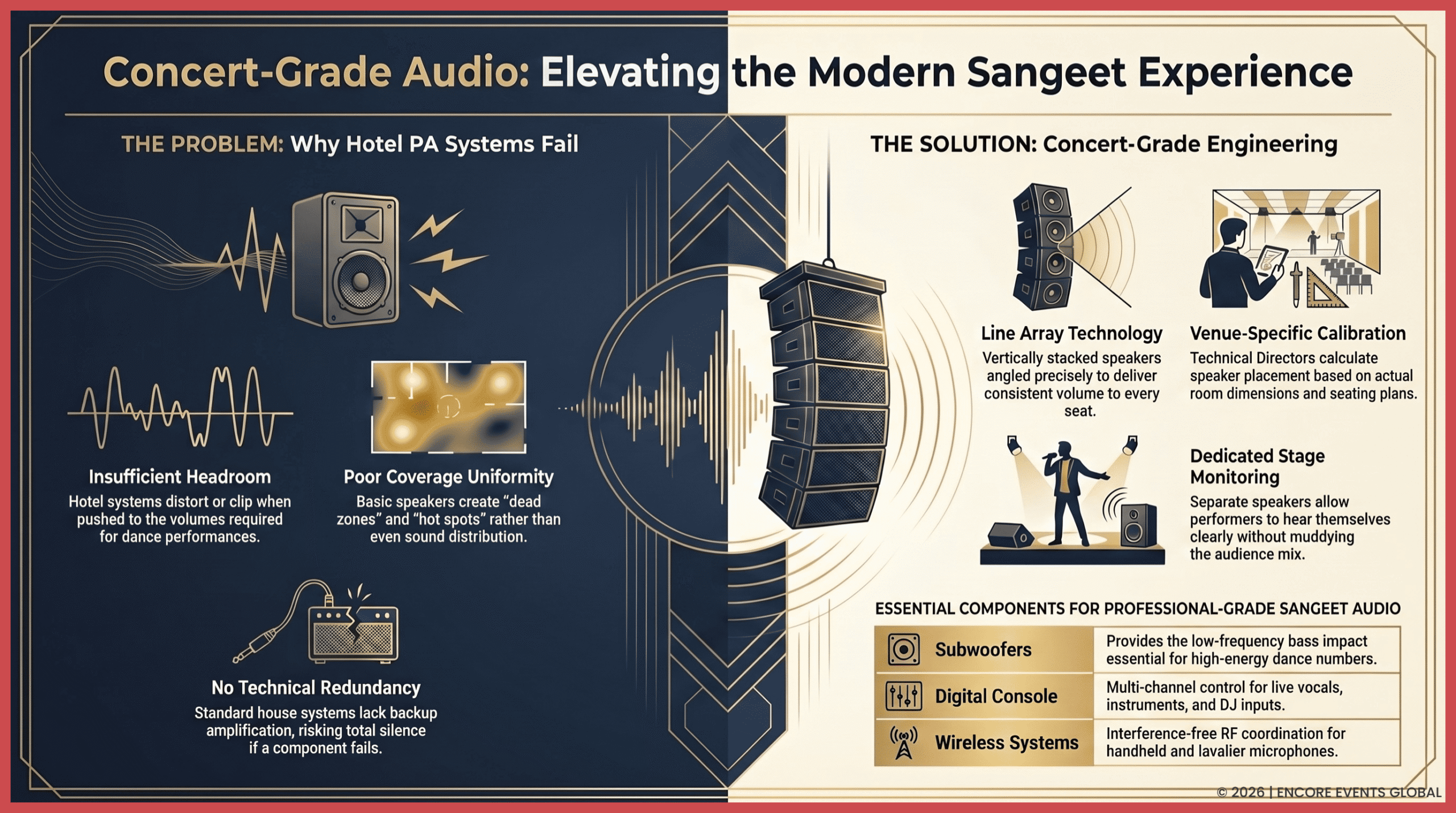
A line array is a speaker configuration where multiple identical speaker cabinets are stacked vertically and angled precisely to project sound evenly across a wide area, rather than relying on a small number of point-source speakers that create uneven coverage — loud near the speaker, weak further away.
This is the same speaker technology used at major concerts and large conferences, because it solves a specific physical problem: getting consistent sound quality and volume to every seat in a large or irregularly shaped space, without the distortion and “hot spots” that come from underpowered or poorly positioned standard speakers.
For a sangeet with 300+ guests seated across a wide hall or outdoor lawn, line array systems are the only practical way to ensure that a guest at the back of the room hears the performance with the same clarity and impact as someone seated in the front row.
Why a Standard Hotel PA System Falls Short
Most hotel banquet halls come with a built-in PA system designed for speeches, announcements, and light background music — not for a multi-hour, high-energy live performance show. The limitations become obvious the moment a sangeet performance begins:
- Insufficient headroom: Hotel systems are typically sized for speech-level volume. Pushed to concert-level volume for a dance performance, they distort, clip, or simply cannot reach the required sound pressure level.
- Poor coverage uniformity: Built-in ceiling speakers or a small number of point-source speakers create dead zones and hot spots across a large room, meaning sound quality varies dramatically depending on where a guest is seated.
- Limited channel capacity: A sangeet with multiple performers, live vocals, a DJ, and recorded tracks needs a mixing console with enough channels and processing capability to handle all of these sources cleanly. Hotel systems are rarely equipped for this.
- No redundancy: If the hotel’s house system fails mid-performance, there is typically no backup. A professional production setup always includes redundant amplification and signal paths.
Coverage vs. Volume: The Real Problem
A common misconception is that the solution to a hotel system’s limitations is simply “more volume.” This misses the actual problem. Cranking up an underpowered or poorly positioned speaker system does not improve coverage — it just makes the distortion and unevenness louder.
The real solution is proper coverage design: positioning line array elements so that sound energy is distributed evenly across the seating area, calculating the throw distance and angle for each speaker cluster based on the room’s actual dimensions, and ensuring that every guest — not just those near the stage — experiences consistent audio quality.
This is a calculation our Technical Directors perform during the venue site inspection, well before the event, using the actual room dimensions and seating plan rather than generic assumptions.
What a Proper Sangeet Sound Setup Includes
| Component | Purpose |
|---|---|
| Line Array Speakers | Main front-of-house sound delivery, calculated and angled for even coverage across the room |
| Subwoofers | Low-frequency reinforcement for the bass impact that high-energy dance numbers require |
| Digital Mixing Console | Multi-channel control for live vocals, instruments, DJ input, and recorded tracks with independent processing |
| Wireless Microphone Systems | Handheld and lavalier mics for performers, hosts, and family speeches with interference-free RF coordination |
| Stage Monitors | Allow performers to hear themselves and the music accurately while on stage, separate from the audience mix |
| Redundant Amplification | Backup signal and power paths to prevent total audio failure mid-performance |
Venue-Specific Considerations
The right audio setup depends heavily on the venue itself, and this is where a generic sound vendor often falls short compared to a production team that conducts proper venue assessment:
- Outdoor lawns: Sound dissipates more in open air, requiring higher output line array systems and careful attention to wind direction, which can shift sound coverage significantly during an outdoor evening event.
- Heritage courtyards: Stone walls and hard surfaces in palace courtyards create reflections and echo that need to be managed through careful speaker positioning and, in some cases, temporary acoustic treatment.
- Indoor ballrooms: Lower ceilings and carpeted, soft-furnished spaces absorb sound differently than outdoor venues, generally requiring less raw power but more precise coverage calculation to avoid uneven hot spots.
- Multi-zone events: If the sangeet includes a cocktail area separate from the main performance space, a distinct, lower-volume audio zone needs to be designed so conversation remains possible away from the stage.
Stage Monitors and Live Mixing
An often-overlooked element of sangeet audio is what the performers themselves hear. Family members and professional dancers performing choreographed numbers need to hear the music accurately and on-time through dedicated stage monitors — separate from what the audience hears through the main line array system.
Without proper monitoring, performers either cannot hear the music clearly enough to stay on beat, or the monitor speakers bleed into the audience sound, muddying the overall mix. A dedicated monitor engineer, working alongside the front-of-house mix engineer, ensures both the performers and the audience get a clean, well-balanced experience simultaneously.
Questions to Ask Your Production Team
- Will the sound system be a line array setup, or a standard PA configuration?
- Has the venue’s actual dimensions and seating plan been used to calculate speaker placement and coverage?
- Is there a dedicated monitor mix for performers, separate from the audience sound?
- What backup or redundancy exists if a primary speaker or amplifier fails mid-performance?
- Will a sound check and technical rehearsal happen before the actual performance, with all performers present?
How Encore Events Global Approaches Sangeet Audio
At Encore Events Global, sangeet sound design is treated as a dedicated technical discipline, not an afterthought bundled into general decor and lighting. Our Technical Director conducts a venue assessment specifically for audio coverage, calculates line array placement based on the actual room or lawn dimensions, and ensures redundant amplification is built into every setup.
We coordinate closely with choreographers and performers ahead of the event to confirm monitor requirements, run a full technical rehearsal with all music and performance cues before the actual night, and have a dedicated front-of-house engineer managing the live mix throughout the performance.
The result is a sangeet that sounds as good as it looks — where every guest, regardless of where they are seated, experiences the full emotional and energetic impact of the performances your family has spent weeks preparing.
If you are planning a sangeet or live performance evening as part of your destination wedding, talk to our team about the right audio setup for your venue.
Frequently Asked Questions
What is line array audio and why does a sangeet need it?
Line array audio is a speaker configuration that delivers even sound coverage across a wide or large area, unlike standard point-source speakers that create uneven volume and dead zones. Sangeets need it because they function as live performances requiring consistent sound quality across the entire guest seating area.
Why is a hotel’s built-in PA system not sufficient for a sangeet?
Hotel PA systems are typically designed for speech and background music, not high-energy multi-hour live performances. They lack the headroom, coverage uniformity, channel capacity, and redundancy that a proper sangeet performance requires.
Do outdoor sangeets need different audio equipment than indoor ones?
Yes. Outdoor venues require higher output line array systems because sound dissipates more in open air, and wind direction can significantly affect coverage. Indoor venues generally need less raw power but more precise coverage calculation due to ceiling height and surface absorption.
What are stage monitors and why do performers need them?
Stage monitors are speakers that let performers hear the music accurately while on stage, separate from what the audience hears through the main system. Without proper monitoring, performers struggle to stay on beat during choreographed numbers.
How does Encore Events Global plan sangeet audio?
Encore’s Technical Director conducts a dedicated audio coverage assessment during the venue site inspection, calculates line array placement based on actual room dimensions, builds in redundant amplification, and runs a full technical rehearsal with performers before the event.
Conclusion
A sangeet performance represents weeks of rehearsal, genuine emotional investment from family members, and a moment the whole family will remember for years. None of that deserves to be undermined by a sound system that was never designed for the job.
Concert-grade line array audio is not an indulgence — it is the technical foundation that ensures every guest, in every seat, experiences the performance the way it was meant to be heard. The difference between a good sangeet and an unforgettable one is, more often than people realise, a question of sound engineering.
Talk to Encore Events Global about getting the audio right for your sangeet or any live performance evening.