

When a company sends 200 employees to Dubai for an incentive trip, the flights and the hotel get most of the planning attention. The visa processing and forex management — two logistics tracks that are just as capable of derailing the entire program — often get treated as administrative afterthoughts.
They are not afterthoughts. A single visa rejection in a group of 200 creates a cascade of problems: a missing team member, a morale issue, a last-minute travel change, and a procurement headache. Multiply that by the complexity of multi-currency expense management, and you have a logistics challenge that deserves dedicated planning from the start.
At Encore Events Global, we manage group visa processing and forex logistics as integrated components of every international MICE program we execute. This guide covers what that actually involves.
Group Visa Basics: What Makes It Different from Individual Travel
Individual visa applications are relatively straightforward. You collect your documents, submit your application, and wait. Group visa processing for corporate travel is a fundamentally different exercise, and the differences matter at every stage.
- Document standardisation: A group of 200 delegates will have 200 different passport formats, expiry dates, photograph qualities, and document histories. Standardising the document collection and verifying each submission before it goes to the consulate or visa agency is a time-intensive process that cannot be rushed.
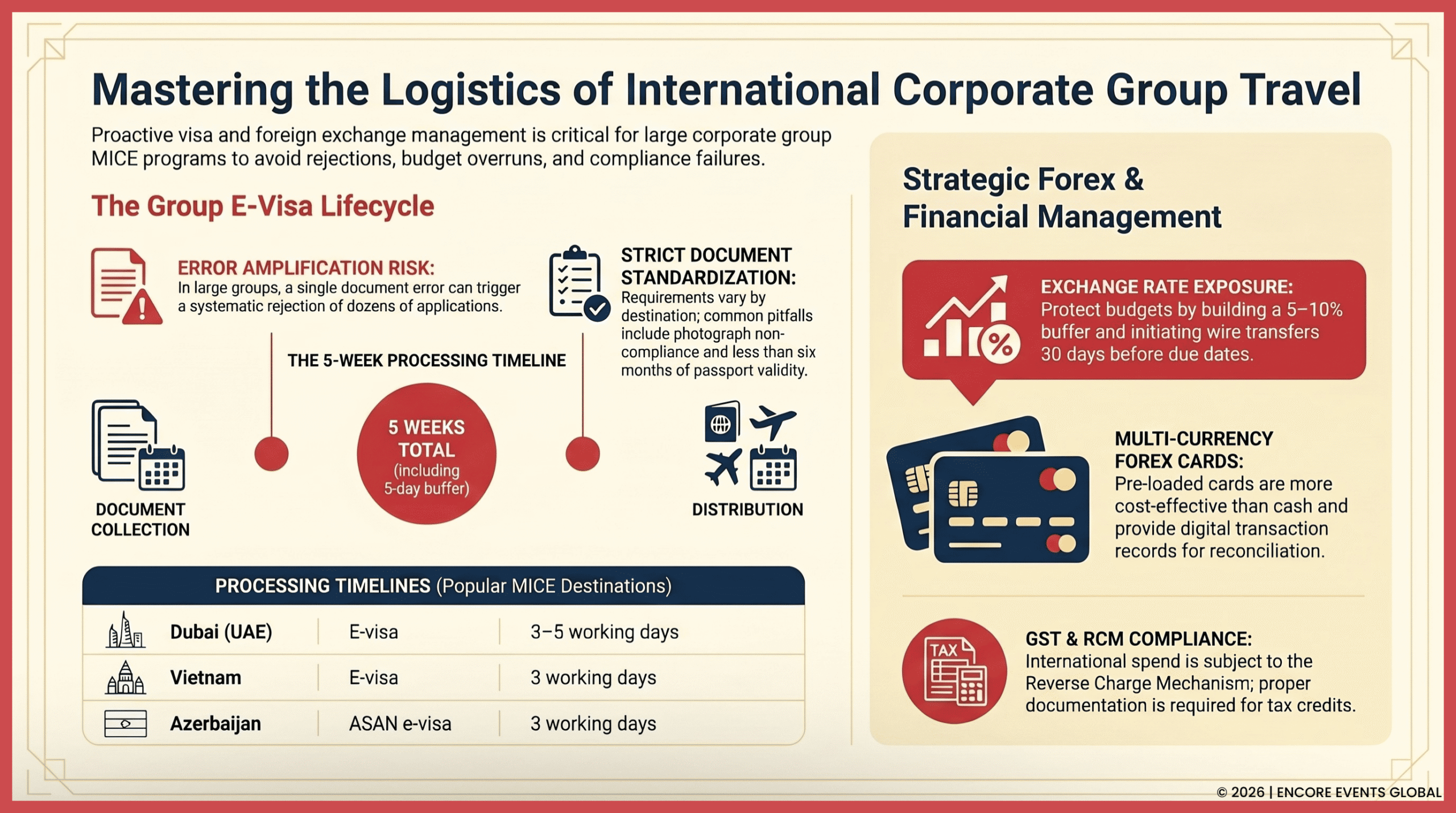
- Error amplification: In individual travel, one document error affects one person. In group processing, a systematic error — wrong photograph format, incorrect employment letter template, missing bank statement page — can affect dozens of applications simultaneously and require a complete resubmission cycle.
- Processing batch management: Most visa agencies process corporate group applications in batches. Understanding the batch schedule, submission deadlines, and processing turnaround for each destination is essential for building a realistic timeline.
- Rejection management protocol: Even with perfect documentation, a small percentage of group visa applications will face queries or rejections. Having a clear escalation and resubmission protocol in place before processing begins is the difference between a manageable problem and a crisis.
The Group E-Visa Process: Step by Step
For e-visa destinations — which include Dubai, most South East Asian countries, and a growing number of Central Asian destinations — the process for group applications follows a standard sequence:
Step 1: Document Collection (Week 1–2)
Issue a standardised document checklist to all delegates covering passport scan (all pages), photograph specifications, travel insurance details, employment letter format, and any destination-specific requirements. Set a firm submission deadline with a buffer for late submissions and error corrections.
Step 2: Document Verification (Week 2)
Each submission must be individually verified against the destination’s requirements before batch submission. Photograph dimensions, passport validity (minimum 6 months from travel date), and document formatting errors must be caught at this stage, not after submission.
Step 3: Batch Submission (Week 3)
Submit verified documents to the visa processing agency or consulate. For e-visa destinations, this is typically an online submission through an authorised portal. Keep a complete record of every submission, including reference numbers and submission timestamps.
Step 4: Processing and Tracking (Week 3–4)
Track processing status for every application in the batch. Most e-visa portals allow status checking by reference number. Build a tracking system that flags any application that falls outside the expected processing window for proactive follow-up.
Step 5: Visa Distribution and Travel Kit Preparation (Week 4–5)
Once visas are issued, compile individual travel kits for each delegate including visa documentation, hotel confirmation, emergency contact numbers, destination-specific guidelines, and any delegate-specific notes (dietary accommodations, medical requirements, room type).
Visa Requirements by Destination
| Destination | Visa Type | Processing Time | Key Requirement |
|---|---|---|---|
| Dubai (UAE) | E-visa (30 or 60 days) | 3–5 working days | Passport copy, photo, hotel confirmation, return ticket |
| Thailand | Visa-free (30 days) or e-visa | Immediate (visa-free) or 3–7 days (e-visa) | Valid passport, onward ticket, proof of funds |
| Vietnam | E-visa (90 days) | 3 working days | Passport photo page, digital photograph, entry/exit details |
| Azerbaijan (Baku) | ASAN e-visa | 3 working days | Passport scan, photo, travel dates, hotel details |
| Kazakhstan (Almaty) | E-visa or visa-free (up to 14 days) | Up to 5 working days | Passport, invitation letter for longer stays, hotel confirmation |
| Singapore | Visa required (embassy application) | 7–14 working days | Full document set including bank statements and employment letter |
Common Visa Errors That Delay Groups
Based on our experience processing group visas for hundreds of corporate delegations, these are the errors that appear most frequently and cause the most disruption:
- Photograph non-compliance: Different destinations have different photograph size, background colour, and recency requirements. A photo that works for one destination may be rejected for another. Always verify against the specific destination’s current specifications.
- Passport validity oversight: Most destinations require a minimum of 6 months validity beyond the travel date. In a group of 200 delegates, it is statistically likely that several passports will fail this check. Identify them early enough for renewal.
- Inconsistent employment letters: Visa authorities check employment letters for specific details — company letterhead, authorised signatory, employee designation, travel purpose, and financial guarantee language. A non-standard template will generate queries.
- Incomplete passport scans: Some destinations require all passport pages including blank pages. Partial scans are a frequent cause of resubmission.
- Late submissions from delegates: In any group of 200, a percentage of delegates will miss the document submission deadline. Build a 5-day buffer between your internal deadline and the actual submission date to accommodate stragglers without affecting the group processing timeline.
Forex Management for Corporate Groups: The Basics
Forex management for international corporate travel involves two distinct tracks: the company’s own foreign currency expenditure on hotels, venues, and vendors, and the individual delegate currency requirements for personal expenses during the trip.
Both tracks need to be planned deliberately. Unmanaged forex on a large corporate event creates several categories of financial risk:
- Exchange rate exposure: A corporate event budget agreed in INR six months before the event can be significantly impacted by exchange rate movements if international vendor payments are not hedged or managed proactively.
- Bank transfer delays: International wire transfers for hotel deposits, venue payments, and vendor advances require advance processing time. Last-minute international payments often incur premium charges and can miss payment deadlines.
- Delegate expense management: If delegates are given cash allowances in foreign currency, the procurement, distribution, and reconciliation of that currency needs a clear process. Ad hoc forex procurement at retail rates is expensive and administratively chaotic.
- Dual currency invoicing: When vendors invoice in foreign currency but the company needs to account in INR, accurate conversion rates and documentation for GST and audit purposes are essential.
Forex Planning: How to Do It Right
Lock in Vendor Payments Early
For international hotel deposits, venue payments, and production vendor advances, initiate wire transfers at least 30 days before the payment due date. This allows for banking processing time, error correction, and takes advantage of a known exchange rate rather than a last-minute spot rate.
Use a Forex Card System for Delegate Allowances
Pre-loaded multi-currency forex cards are significantly more cost-effective and administratively manageable than cash currency distribution for large groups. They offer better exchange rates than retail forex counters, provide a digital transaction record for expense reconciliation, and can be topped up remotely if a delegate’s allowance runs short.
Build Exchange Rate Buffers Into the Budget
When budgeting for an international MICE event three to six months in advance, build a 5–10% forex buffer into all internationally denominated costs. This protects the overall budget from adverse rate movements without requiring complex hedging instruments.
Maintain Clear Documentation for All Foreign Payments
Every international payment — hotel deposit, venue advance, vendor payment — must be accompanied by a purpose of remittance code, a foreign currency invoice from the recipient, and a bank-certified exchange rate certificate. This documentation is required for GST input credit claims and statutory audit compliance.
Multi-Currency Events: Managing Complexity
Some international MICE programs involve multiple countries — a conference in Dubai followed by an incentive extension in Oman, or a multi-city roadshow across Thailand and Vietnam. Multi-currency events add a layer of financial complexity that requires dedicated management.
Key considerations for multi-currency programs include:
- Currency priority mapping: Identify which currency is the primary invoicing currency for each destination and establish separate budget lines for each currency exposure.
- Delegate allowance structure: For multi-country programs, pre-loaded forex cards with multiple currency wallets are the most practical solution. Brief delegates clearly on which card wallet to use in which country.
- Vendor payment sequencing: Map all vendor payment due dates against the program timeline and initiate transfers in sequence, with at least 10 days before each due date to account for banking processing time.
- Consolidated expense reporting: All multi-currency expenses must be converted to INR at the certified exchange rate for each transaction date for statutory reporting. Establish this conversion protocol before the event, not during the expense reconciliation phase afterwards.
GST Compliance and Input Tax Credit on International Spend
International corporate event spend has specific GST implications that Indian companies frequently mishandle. The key points to understand:
- Import of services: When an Indian company pays a foreign vendor for services rendered outside India (hotel, venue, production), this constitutes an import of services under GST and is subject to reverse charge mechanism (RCM). The Indian company must self-assess and pay IGST under RCM on these payments.
- Input Tax Credit availability: IGST paid under RCM on international service imports is generally available as Input Tax Credit, provided the services are used for business purposes and proper documentation is maintained.
- Foreign currency invoice requirement: To claim ITC on international spend, the company must hold a valid foreign currency invoice from the overseas supplier, along with a bank certificate of remittance and the purpose of remittance code.
- Place of supply rules: The GST place of supply rules for imported services determine whether IGST applies. Incorrect classification can result in incorrect tax treatment and potential compliance issues during audit.
We strongly recommend involving your company’s GST consultant in the planning of any significant international MICE program to ensure correct tax treatment from the outset.
How Encore Events Global Manages Visa and Forex Logistics
At Encore Events Global, group visa processing and forex management are standard components of our international MICE service, not optional add-ons.
Our dedicated logistics team manages the complete visa processing cycle — document checklist issuance, collection, verification, batch submission, tracking, and travel kit compilation — for every international corporate group we handle. We maintain current knowledge of visa requirements for all our primary MICE destinations and have established relationships with authorised processing agencies that provide reliable turnaround times.
On the forex side, our Single-Window Billing model means that clients receive a single GST-compliant invoice in INR covering all international vendor payments, eliminating the need to manage multiple foreign currency payments, purpose of remittance codes, and foreign currency invoice documentation internally. We handle the international payment infrastructure; your finance team gets a clean, auditable single invoice.
If you are planning an international corporate event and want to understand how we manage the visa and forex logistics end-to-end, get in touch with our team for a detailed briefing.
Frequently Asked Questions
How long does group e-visa processing take for Dubai?
UAE e-visas for Indian nationals typically process in 3–5 working days per application. For a group of 200 delegates, allow 3–4 weeks total to account for document collection, verification, batch submission, processing, and error correction. Initiate the process at least 6 weeks before travel.
What documents are required for a corporate group visa application?
Standard documents include a passport copy (all pages), a compliant photograph, an employment letter on company letterhead, hotel confirmation, return flight ticket, and travel insurance. Some destinations also require bank statements or a company financial guarantee letter. Requirements vary by destination and must be verified for each program.
What is the best way to manage forex for a large corporate group?
Pre-loaded multi-currency forex cards are the most practical solution for delegate allowances, offering better rates than retail counters and a digital transaction record. For company-level international payments, initiate wire transfers at least 30 days before due dates and build a 5–10% exchange rate buffer into internationally denominated budget lines.
Are there GST implications for international corporate event spend?
Yes. Payments to foreign vendors for services rendered outside India constitute import of services under GST, subject to reverse charge mechanism. IGST paid under RCM is generally available as Input Tax Credit with proper documentation. Consult your GST advisor before finalising international MICE budgets.
How does Encore Events Global handle group visa processing?
Encore manages the complete visa processing cycle as a standard component of international MICE programs — from document checklist issuance and collection through verification, batch submission, status tracking, and travel kit compilation. The Single-Window Billing model also eliminates the need for clients to manage foreign currency vendor payments directly.
Conclusion
Group e-visa processing and forex management are not glamorous parts of international corporate travel planning. But they are the parts most likely to cause serious operational disruption if handled poorly. A visa rejection in a group of 200 is not just an administrative problem — it is a morale and logistics problem that ripples through the entire program.
The good news is that both tracks are entirely manageable with the right process, the right lead time, and the right partner. When visa and forex logistics are integrated into the MICE planning timeline from the start — rather than bolted on as an afterthought — they become routine rather than stressful.
Talk to Encore Events Global about managing the complete logistics chain for your next international corporate event.
“