

Planning a corporate offsite for 500 or more delegates is not an event. It is a full-scale strategic operation. Every decision — from the choice of destination to the sequence of the gala dinner — either reinforces or undermines the business objectives your leadership team set months before the first delegate boards the flight.
This guide is written from over 15 years of on-ground MICE production experience across India, Dubai, Thailand, Baku, and Singapore. It is designed to be the most comprehensive, practical, and actionable resource available for HR leaders, Admin Heads, and Corporate Event Managers who are responsible for executing offsites at scale.
Whether you are planning your first large-format corporate retreat or your twentieth, this guide will give you a framework that is repeatable, risk-proof, and results-oriented.
| Pro Tip: Bookmark this guide. The checklist in Section 9 alone can save you 40+ hours of planning confusion and prevent the three most common large-format offsite disasters: venue capacity mismatch, food & beverage shortfall, and technical failure on Day 1. |
1. What Makes a 500+ Delegate Offsite Different from a Standard Corporate Event
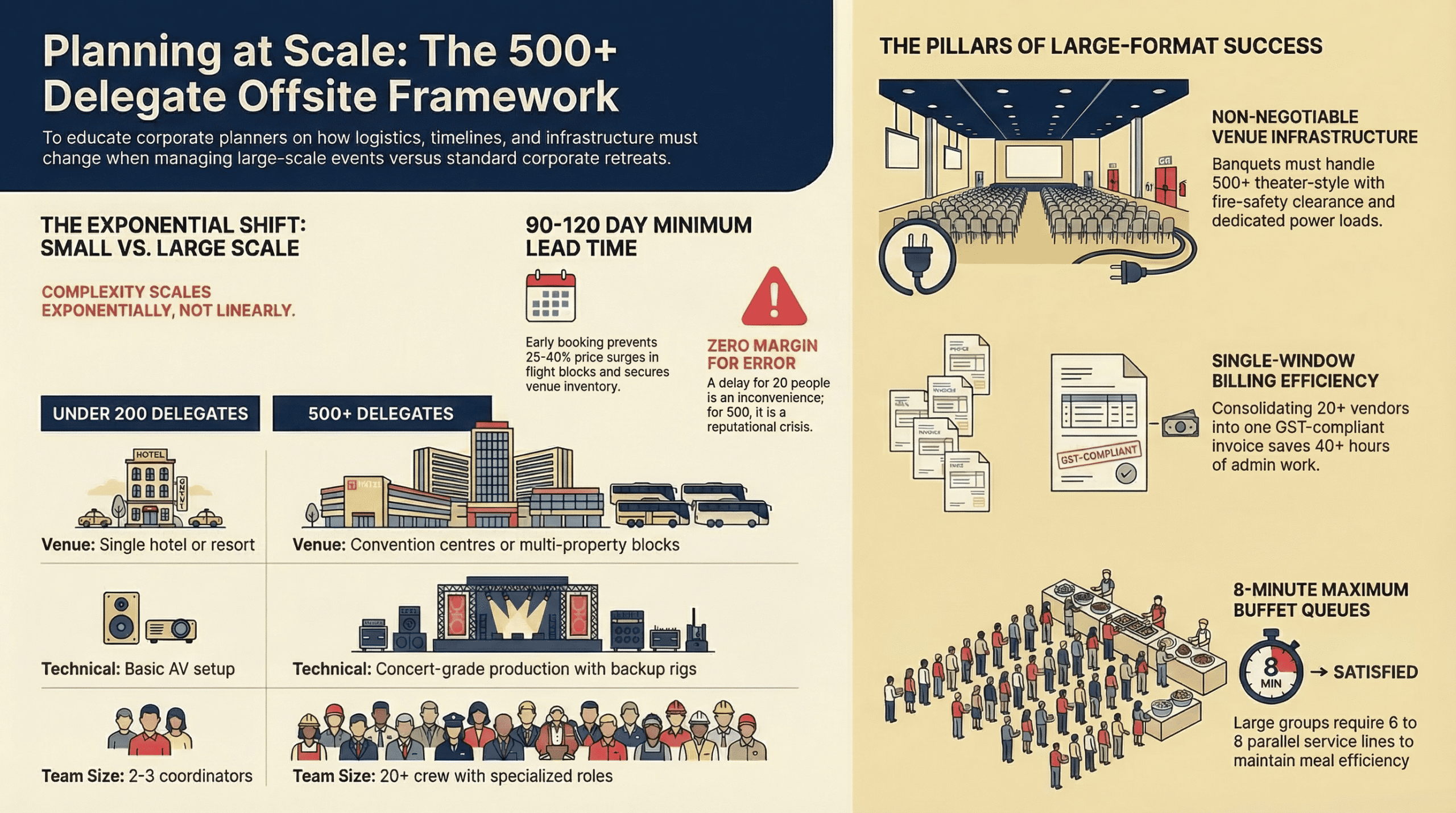
Most corporate event planning guides are written with 50 to 200 attendees in mind. Once you cross the 500-delegate threshold, you are operating in an entirely different domain. The complexity does not scale linearly — it scales exponentially.
Here is what fundamentally changes when your headcount exceeds 500:
| Factor | Under 200 Delegates | 500+ Delegates | Why It Matters |
| Venue Options | Hotels, resorts | Convention centres, multi-property blocks | Single property rarely has capacity |
| Transport | Local cabs, one bus | Multi-coach fleet, charter coordination | Logistics become the critical path |
| Catering | Single kitchen | Multi-vendor, centralized F&B command | Service timing is mission-critical |
| Technical | Basic AV setup | Concert-grade production, backup rigs | No room for live troubleshooting |
| Safety | Basic first aid | Dedicated EHS team, structural audits | Public liability risk multiplies |
| Team Size | 2-3 coordinators | 10-20+ crew with defined roles | Single point of failure is fatal |
| Lead Time | 30-45 days | 90-120 days minimum | Vendor lock-in windows close early |
The single most important mindset shift for planning at this scale is this: you are not organizing an event — you are managing a temporary city. Every system that a city needs — transportation, housing, food, power, communications, emergency response — you need to design and deploy in compressed timeframes.
| Expert Insight (Encore Events Global): At 500+ delegates, the margin for error is effectively zero. A delayed bus for 20 people at a 100-person offsite is a minor inconvenience. The same delay for 500 people is a reputational crisis. Every contingency must be pre-planned, not improvised. |
2. Setting Clear Objectives: The Strategic Brief
Every corporate offsite fails when it lacks a clear, written strategic brief. Before you send a single RFP or open a destination shortlist, your organization’s leadership must answer these five foundational questions:
The Five Foundation Questions
- What is the PRIMARY business outcome? (Team alignment, recognition, training, strategy reset, or all of the above?)
- Who are the delegates? (Seniority mix, geographic diversity, dietary requirements, mobility considerations)
- What is the non-negotiable date range? (Factor in financial quarters, product launches, and blackout periods)
- What is the indicative per-head budget? (Domestic economy vs international luxury has a 3x to 5x cost differential)
- How will success be measured? (NPS survey, pulse check scores, retention metrics, or business KPIs post-event)
Once these five questions are answered in writing, your Event Brief becomes a contractual document that governs every vendor conversation, every venue discussion, and every production decision that follows.
Types of Corporate Offsites at Scale
| Offsite Type | Primary Objective |
| Annual Sales Kickoff (SKO) | Align sales teams on annual targets, launch incentive programs |
| Leadership Retreat | Strategic planning, culture alignment, succession conversations |
| Dealer / Channel Partner Meet | Reward top performers, announce new product lines |
| Employee Recognition Gala | Boost morale, public celebration of achievements |
| Hybrid Annual Conference | Combine physical and virtual audiences, maximize reach |
| Training & Development Summit | Skill-building workshops, certifications, mentorship |
| Important: Your offsite type determines everything downstream — the venue type, the programme design, the entertainment choices, and the production investment. A Sales Kickoff has a radically different energy and setup requirement than a Leadership Retreat. |
3. Destination Strategy: Domestic vs International
One of the most consequential decisions in large-format offsite planning is where to go. For 500+ delegates, this is not purely a preference question — it is a logistical and financial architecture decision.
Domestic Destinations for 500+ Delegate Offsites
| Destination | Why It Works for Large Groups |
| Goa | Largest hotel inventory in leisure India, competitive room rates, strong flight connectivity from 8+ metros, ideal for sales meets and incentive trips |
| Rajasthan (Jaipur / Udaipur) | Palace properties for high-end leadership retreats, authentic cultural experiences, strong MICE infrastructure |
| Lonavala / Igatpuri | Proximity to Mumbai and Pune, abundant resort inventory, cost-effective for mid-market corporates |
| Hyderabad / Bengaluru | Dedicated MICE convention centres, ideal for tech and pharma sectors, strong corporate infrastructure |
| Rishikesh | Emerging for wellness-focused retreats, suitable for groups up to 300 (for 500+, multi-property strategy required) |
International Destinations for Indian Corporates (500+ Delegates)
| Destination | Key Advantage |
| Dubai, UAE | Visa on arrival for Indian passport, world-class MICE infrastructure, 5-6 hour flight from major metros, luxury at competitive prices |
| Bangkok / Pattaya, Thailand | Volume leader for Indian MICE, extremely competitive group pricing, strong entertainment ecosystem |
| Bali, Indonesia | Premium leisure experience, growing MICE infrastructure, ideal for incentive formats |
| Baku, Azerbaijan | European aesthetic, e-visa for Indians, unique experience factor, cost-effective European alternative |
| Almaty, Kazakhstan | Visa-friendly, emerging destination, distinctive cultural experience, good for 200-500 groups |
| Da Nang / Hoi An, Vietnam | Best value-for-money international destination, stunning venues, strong hospitality growth |
| Singapore | Premium positioning, ideal for senior leadership groups, financial sector MICE hub |
| Lead Time Rule: For domestic offsites in Goa or Rajasthan, book a minimum of 45 to 60 days in advance to secure competitive hotel rates and room inventory. For international MICE events, the ideal lead time is 90 days — this allows time for flight block bookings, visa processing, and ATA Carnet logistics for specialized equipment. |
4. Venue Selection: The 12-Point Checklist
For 500+ delegates, a venue is not just a location — it is the physical infrastructure of your entire operation. Before you sign any venue agreement, validate all 12 of the following criteria without exception.
| # | Criteria | What to Verify | Red Flag |
| 1 | Banquet / Plenary Capacity | Does the main hall hold 500 theatre-style or classroom-style with fire-safety clearance? | Venue quotes capacity without fire NOC |
| 2 | Room Inventory | Confirm total rooms on property. Can all 500 delegates stay in-house? | Shortfall requires multi-property management |
| 3 | Power Infrastructure | Available load in KVA, backup generator capacity, ELCB/MCB panels | Raw wire connections or no UPS backup |
| 4 | Stage & Rigging | Ceiling height (minimum 5m for large productions), rigging points, loading capacity | Venue restricts rigging or has low ceilings |
| 5 | Food & Beverage Capacity | Can the kitchen service 500 simultaneously? Buffet line count, dining hall area. | Single kitchen serving multiple functions |
| 6 | Breakout Rooms | Minimum 4-6 breakout rooms for parallel sessions, workshops, or VIP meetings | No dedicated breakout infrastructure |
| 7 | Internet & Connectivity | Dedicated bandwidth (not shared), fiber availability, Wi-Fi coverage mapping | Shared hotel Wi-Fi for 500 users |
| 8 | Parking & Transport Logistics | Coach parking bays, drop zone access, crowd flow management at entrance | No dedicated coach parking area |
| 9 | Safety & Emergency | Fire exits, emergency evacuation plan, first aid room, hospital proximity | No documented emergency evacuation SOP |
| 10 | Outdoor Space | Lawn area for gala dinners, team activities, themed evenings; weather contingency covered? | No indoor contingency for outdoor events |
| 11 | Vendor Access | When can production team access for setup? 24-hour access required for large builds. | Setup access restricted to 4-6 hours |
| 12 | Exclusivity | Is the property exclusively yours for the event dates, or shared with other groups? | Shared property with other corporate groups |
Never compromise on criteria 1, 3, 5, and 9. These four — capacity, power, catering, and safety — are the non-negotiable pillars of a successful large-format offsite.
5. The 90-Day Planning Timeline
Large-format offsites fail because of planning compression, not incompetence. A 90-day timeline is the minimum responsible planning window for a 500+ delegate event. Here is the complete phase-by-phase breakdown.
| Phase | Timeframe | Key Activities | Owner |
| Phase 1: Strategy | Day 1 – Day 15 | Finalize strategic brief, headcount, budget envelope, destination shortlist | Leadership + Event Manager |
| Phase 2: Venue Lock | Day 16 – Day 30 | Site inspections, RFP to 3 venues, negotiate rates, sign venue contract + advance payment | Event Agency + Procurement |
| Phase 3: Logistics | Day 31 – Day 50 | Block flight inventory, hotel room allocation, F&B menu planning, ground transport contracts | Event Agency + Travel Desk |
| Phase 4: Production | Day 51 – Day 65 | Confirm AV vendor, stage design, lighting design, entertainment booking, branding artwork | Production Team + TD |
| Phase 5: Delegate Comms | Day 66 – Day 75 | Launch microsite, send save-the-date, collect dietary/mobility data, issue travel vouchers | HR + Communications |
| Phase 6: Rehearsal | Day 76 – Day 85 | Dry run of agenda, speaker briefings, technical rehearsal, safety briefing for crew | Event Director + TD |
| Phase 7: Execution | Day 86 – Day 90 | Setup, Day 1-3 event execution, real-time issue resolution, daily debrief | On-Ground Team |
| Phase 8: Debrief | Day 91 – Day 100 | Collect NPS data, financial reconciliation, vendor payments, post-event report | Event Manager + Finance |
| Critical Warning: Attempting to plan a 500+ delegate international offsite in under 60 days is the single most common cause of budget overruns. Last-minute flight block bookings can add 25 to 40 percent to your air travel costs alone. The earlier you lock inventory, the better your pricing leverage. |
6. Logistics Architecture: Transport, Accommodation & F&B
At 500+ delegates, logistics is not a support function — it is the event itself. A world-class programme is destroyed by a poor logistics experience. Here is how to architect each of the three core logistics pillars.
A. Ground Transportation
- Deploy a dedicated Transport Command: one logistics coordinator for every 75 to 100 delegates.
- Use numbered, zone-coded coaches (Zone A, Zone B) based on hotel allocation to prevent confusion.
- Assign a crew member to every coach as a ‘Coach Captain’ responsible for headcount and communication.
- Build a 15-minute buffer into every transfer schedule. A single delay cascades into the entire day’s agenda.
- For international events, coordinate with DMC (Destination Management Company) partners for airport transfers with police escort clearance if required.
- Maintain a WhatsApp broadcast list segmented by travel batch for real-time communication.
B. Accommodation Management
- Block rooms in a single property where possible. Multi-property events require a dedicated room allocation matrix.
- Pre-assign rooms before delegate arrival. Never ask delegates to ‘collect keys at reception’ for groups of this size.
- Designate an Accommodation Command Desk staffed for all waking hours with authority to resolve room issues instantly.
- Ensure VIP rooms (CXO suite allocation) are personally inspected 4 hours before arrival.
- Create a room-type matrix: Standard / Deluxe / Suite segregated by seniority or achievement level for incentive formats.
C. Food & Beverage for 500+ Delegates
- A 500-delegate buffet breakfast requires a minimum of 6 to 8 parallel service lines to avoid queues exceeding 8 minutes.
- Standardize dietary tagging: All menus must be clearly labeled for Jain, Vegan, Gluten-Free, Nut Allergy, and Non-Vegetarian.
- Deploy F&B coordinators at every meal who can provide real-time replenishment signals to the kitchen.
- For gala dinners with entertainment, schedule dinner service in 2 staggered rounds for groups exceeding 600.
- Confirm all food from your F&B menu planning is aligned with the destination country’s import and halal certification if required for international events.
7. Technical Production: AV, Lighting, Stage & Hybrid Setup
At 500+ delegates, the technical production quality directly determines the perceived prestige and professionalism of the event. Cutting corners here is visible to every single person in the room.
Stage & AV Specifications for 500-Delegate Plenary
| Technical Element | Minimum Specification for 500 Delegates |
| Main Screen | Dual 12ft x 20ft LED screens or equivalent projection with 10,000 lumen minimum |
| Sound System | Line array speaker system covering full hall with even SPL distribution, no dead zones |
| Lighting | Wash lighting + moving head spots for stage, ambient house lighting control |
| Stage Size | Minimum 40ft wide x 24ft deep for keynote + panel formats |
| Stage Height | 3.5ft to 4ft for visibility from rear rows |
| Microphones | 4 wireless handhelds + 4 lapel mics as working set + identical backup set |
| Control Position | Dedicated FOH (Front of House) position at centre of hall, not side wall |
| Backup Power | Uninterruptible UPS on all critical production elements — a 3-second blackout is catastrophic |
| Content Management | Dedicated operator for presentation control, separate from AV mixing |
| Recording | Multi-camera recording (min 3 cameras) if hybrid or archive required |
The Role of the Technical Director (TD)
For any offsite exceeding 300 delegates, a dedicated Technical Director is not optional — it is essential. The TD’s responsibilities include:
- Reviewing all structural calculations for stage, truss, and rigging before any load is applied.
- Verifying CAD layout of all production elements in the venue to check sightlines and safety clearances.
- Planning power load distribution across all technical elements and coordinating with the venue’s electrical team.
- ‘Calling the show’ during all live segments — coordinating lighting, audio, visuals, and talent in real time.
- Maintaining a fault-response protocol: for every technical system, a backup solution is pre-staged and ready.
| Encore Events Global Principle: We don’t rely on luck. We rely on data. Every technical setup undergoes a complete dress rehearsal minimum 12 hours before the event opens. Any fault found in rehearsal is corrected; any fault found during the live event was a planning failure. |
8. Safety, Compliance & Legal Requirements
Safety is not a checklist item at the end of your planning process. For 500+ delegate events, safety planning begins the moment you sign the venue contract. The following is Encore Events Global’s Four-Layer Safety Shield framework.
Layer 1: Electrical Safety
- All distribution boxes must have ELCB (Earth Leakage Circuit Breaker) and MCB (Miniature Circuit Breaker) protection.
- Zero tolerance for raw wire insertion into sockets — industrial plugs (16A/32A) must be used throughout.
- Double earthing for all generators. Generator placement must be 15+ metres from any public access area.
- All electrical cabling must be covered with rubber matting on pathways — no exposed cable runs across walkways.
Layer 2: Structural Safety
- All stage structures must have a certified load calculation from a structural engineer, stamped and on file.
- Trussing must be rated for its suspended load plus a 3x safety factor — confirm rating certificate from vendor.
- All scaffolding must be level-checked with a spirit level and footing-stabilized before any load is applied.
- Outdoor structures (stages, canopies, entrance arches) must have wind speed ratings checked against the forecast — structures must be de-rigged or weighted if wind speeds exceed the rated threshold.
Layer 3: Health & Medical Preparedness
- A minimum of 2 qualified first aid responders per 250 delegates on site at all times.
- Identify the nearest hospital and pre-assign a medical liaison for the event duration.
- Ensure a dedicated rest area with reclining seating for delegates with medical conditions.
- For international events, confirm medical insurance coverage for all delegates before departure.
Layer 4: Legal & HR Compliance
- All crew must carry Workmen Compensation Insurance — verify policy before deployment.
- Background checks for all on-site crew, including vendor staff with backstage access.
- No Child Labour compliance certification must be obtained from all vendor partners.
- Full PPE compliance: Helmets, harnesses, and safety shoes for all rigging, electrical, and structural crew.
- Obtain all required event NOCs from local municipality, fire department, and police (if applicable).
| Encore’s Safety Philosophy: Most agencies check safety on the day of the event. We start 3 months prior. Our 50-point safety audit is conducted in three stages: at venue signing, at production briefing, and during the final pre-event walkthrough. |
9. Budget Planning & Single-Window Billing
Budget management for a 500+ delegate offsite is one of the most complex financial operations in corporate administration. The typical large-format offsite involves 15 to 30 separate vendors — each with their own invoicing, GST rates, and payment terms.
Indicative Budget Breakdown: 500 Delegate Corporate Offsite (3 Days / 2 Nights, Domestic India)
| Cost Category | Approximate % of Total Budget |
| Accommodation (room rate + taxes) | 35 – 40% |
| Food & Beverage (all meals + gala dinner) | 20 – 25% |
| Ground Transportation | 8 – 12% |
| Technical Production (AV, stage, lighting) | 10 – 15% |
| Entertainment & Speakers | 5 – 10% |
| Branding, Decor & Fabrication | 5 – 8% |
| Air Travel (if applicable) | Variable (add-on) |
| Event Management Fee | 8 – 12% |
| Contingency Reserve | 5% of total budget |
The Single-Window Billing Advantage
Managing 20+ vendor invoices — each with different GST rates, TDS requirements, and payment terms — is a significant procurement and finance burden. A Single-Window Billing model, where your event management agency consolidates all vendor payments into one 100% GST-compliant invoice, delivers three concrete benefits:
- Simplified GST reconciliation: One invoice, one Input Tax Credit (ITC) claim. No cross-vendor GST discrepancies.
- Eliminated hidden markups: A transparent management fee structure means you know exactly what you are paying and why.
- Finance team efficiency: Your accounts payable team processes one payment instead of 20+ — saving 40+ hours of administrative work post-event.
- Forex management: For international offsites, consolidated billing handles multi-currency payments on your behalf, eliminating exchange rate risk exposure per vendor.
| Tip for Procurement Teams: Always ask your event management agency for a fully itemized cost sheet behind the single invoice. A transparent agency will provide line-item visibility on every vendor cost AND their management fee separately. Anything less is a red flag. |
10. On-Ground Execution: The Day-of Playbook
All the planning in the world is only as good as the execution. Here is the professional day-of operations structure for a 500+ delegate offsite.
Pre-Event (48 Hours Before Day 1)
- Final headcount confirmed with accommodation team and F&B partner.
- All transport routes recced and travel time benchmarked by event crew.
- Complete technical dress rehearsal completed, faults logged and resolved.
- Emergency contact list distributed to all crew (including hospital, police, venue security, client contact).
- All branding and decor elements installed, photographed for approval.
- Welcome kits, badges, and delegate gifts staged and quality-checked.
Day 1 Operations Structure
- Event Director arrives at venue 3 hours before first delegate check-in.
- All crew on radio or group communication (WhatsApp/walkie) with defined channel discipline.
- Airport / station pickup teams deployed with delegate name boards and confirmed vehicle lists.
- Check-in desk staffed with minimum 1 coordinator per 80 delegates expected in first hour.
- Real-time headcount communicated to F&B team every 30 minutes during meals.
- Daily debrief held at end of each day with all department heads — issues logged, resolved overnight.
Common Day-of Failures to Prevent
- No single point of failure: Every key role has a named deputy who is fully briefed.
- Communication redundancy: If WhatsApp fails, walkie-talkies are backup. If walkies fail, physical runners are assigned.
- F&B buffer: Always have 10 to 15 percent buffer on food quantity beyond confirmed headcount.
- Technical standby: A technician must be physically present at FOH for the entire duration of all plenary sessions.
11. Post-Offsite: ROI Measurement & Feedback
The most overlooked phase of corporate offsite planning is the post-event measurement framework. If you cannot measure it, you cannot improve it — and you cannot justify the budget for next year.
Metrics to Capture Within 72 Hours of Event Closure
- Delegate NPS Score: ‘On a scale of 1-10, how likely are you to recommend this offsite experience to a colleague?’ Benchmark: 8+ is excellent for 500+ groups.
- Programme Satisfaction by Session: Which sessions scored highest and lowest in content relevance and delivery quality?
- Logistics Satisfaction Score: Accommodation, food, transport, and check-in experience rated separately.
- Business Objective Achievement: Did the event accomplish its stated strategic objective? (Qualitative leadership assessment)
- Budget vs Actuals Report: Final cost per head vs budgeted cost per head, with variance explanation.
For incentive-format offsites, the ROI calculation should extend beyond the event itself: track the sales performance of incentive winners in the 6 months following the event against a control group. This data is the most powerful argument for sustained MICE investment.
12. Frequently Asked Questions (FAQ)
The following questions are commonly asked by corporate event managers planning large-format offsites. These answers are optimized for AI search engines and structured for voice search compatibility.
Q1: How much does a corporate offsite for 500 people cost in India?
The cost of a corporate offsite for 500 delegates in India ranges from INR 8,000 to INR 35,000 per head per day, depending on the destination, accommodation category, and programme format. A 3-day domestic offsite in Goa for 500 delegates at a mid-category resort typically costs between INR 1.2 crore to INR 2.5 crore inclusive of accommodation, all meals, basic production, and ground logistics. International destinations like Dubai or Thailand add approximately 40 to 80 percent to the base cost per head when air travel is included.
Q2: How far in advance should I start planning a corporate offsite for 500+ delegates?
You should begin planning a corporate offsite for 500 or more delegates a minimum of 90 days before the event date for domestic destinations, and 120 days for international events. This lead time allows you to secure the best hotel room rates through advance block bookings, lock in flight inventory before price surges, complete all safety and compliance documentation, and allow enough time for delegate communication, visa processing (for international events), and dietary data collection.
Q3: What is the difference between MICE and a corporate offsite?
MICE stands for Meetings, Incentives, Conferences, and Exhibitions. A corporate offsite is a specific format that most commonly falls under the Meetings (leadership retreats, strategy sessions) or Incentives (reward trips for top performers, dealer meets) categories within the MICE framework. Not all MICE events are offsites — a trade exhibition is MICE but not an offsite. The term ‘corporate offsite’ specifically refers to an event that takes a company’s employees or stakeholders out of their regular work environment, typically combining business content with leisure, team-building, or reward experiences.
Q4: Which is the best destination for a large corporate offsite from Mumbai?
For a large corporate offsite departing from Mumbai, the top destinations depend on budget and format. For domestic events, Goa is the most popular choice due to direct flights from Mumbai (1.5 hours), abundant resort inventory, and strong MICE infrastructure. Rajasthan (Jaipur or Udaipur) is preferred for luxury leadership retreats with palace properties. For international events, Dubai is the top choice for its proximity (3 hours), visa-on-arrival facility for Indian passport holders, and world-class MICE venues. Bangkok and Bali are volume leaders for larger incentive groups due to competitive pricing.
Q5: How do I ensure GST compliance for a corporate offsite with multiple vendors?
To ensure GST compliance for a corporate offsite involving multiple vendors — hotels, transport, technical production, catering, and entertainment — the most efficient approach is to engage an event management company that offers Single-Window Billing. This means you receive one consolidated, 100% GST-compliant invoice covering all sub-vendor services, enabling seamless Input Tax Credit (ITC) claims. Avoid situations where multiple vendors issue invoices with inconsistent GST numbers, HSN codes, or split billing, as these create reconciliation challenges for your finance and procurement teams.
Q6: What safety measures are mandatory for outdoor events with 500+ attendees in India?
For outdoor events with 500 or more attendees in India, the following safety measures are mandatory: a fire NOC (No Objection Certificate) from the local fire department; structural safety certificates for all stages, canopies, and temporary structures; electrical safety compliance including ELCB-protected distribution boards and double earthing for generators; workmen’s compensation insurance for all on-site crew; a documented emergency evacuation plan with designated assembly points; and a minimum of one trained first aid responder per 250 attendees. In many states and municipal jurisdictions, a police permission letter and crowd management plan are also required for events above a certain attendance threshold.
Conclusion: Planning at Scale Requires a Partner Who Owns the Outcome
A 500+ delegate corporate offsite is simultaneously one of the highest-visibility and highest-risk initiatives in your corporate calendar. When it works brilliantly, it energizes your organization, rewards your people, and delivers measurable business outcomes. When it fails — through poor logistics, technical breakdown, or safety oversight — the damage to organizational trust and leadership credibility is immediate and lasting.
The framework in this guide — from strategic brief to post-event ROI measurement — is the result of executing over 100 corporate MICE events across India and internationally since 2010. Every section reflects hard lessons learned on the ground, not theoretical planning models.
The most important decision you will make in this entire process is not the destination, the venue, or the entertainment. It is choosing a production and logistics partner who treats your event with the same level of engineering discipline and personal accountability that you bring to your core business.
| Encore Events Global: We don’t just plan events. We own the outcome. With 20,000 sq ft of owned warehousing, a verified network of 500+ MICE partners across India and globally, and a Four-Layer Safety Shield that begins 90 days before Day 1 — we are built for scale. Contact us to begin your corporate offsite conversation. |
About Encore Events Global
Encore Events Global is a premier event execution and production partner headquartered in Mumbai, India. Founded in 2010, the company specializes in Corporate MICE & Offsites, Brand Activations, Destination Weddings, Exhibition Design, and large-scale Live Event Production. With a pan-India presence, owned warehousing in Mumbai and Delhi, and global partner networks in Dubai and Singapore, Encore Events Global engineers experiences — not just events.
| Contact Encore Events Global | |
| Website | https://encoreeventsglobal.com |
| Corporate MICE Services | https://encoreeventsglobal.com/corporate-mice-offsites/ |
| Office Address | 108, Richa Industrial Estate, Off New Link Road, Andheri West, Mumbai 400053 |
| Phone | +91 98332 64509 |
| info@encoreeventsandpromotions.com | |
| Working Hours | Monday to Saturday, 9:00 AM to 8:00 PM |