

Ask most Indian families how they imagine planning a destination wedding, and the picture usually starts with a decorator — someone who handles flowers, drapes, and a beautifully lit mandap. For decades, that was a reasonable mental model. It is no longer an accurate one.
A 400-guest wedding across three venues in Udaipur, with a charter flight bringing in out-of-town guests, a concert-grade sound system for the sangeet, and 3D projection mapping on a 250-year-old palace facade, is not a decor project. It is a multi-day production involving structural engineering, logistics coordination, international guest management, and the kind of risk planning typically associated with corporate events — not weddings.
At Encore Events Global, we position ourselves explicitly as a production house for weddings, not a decoration agency. This distinction is not branding semantics. It changes everything about how the event is planned, staffed, and executed.
Decorator vs. Production House: What Actually Changes
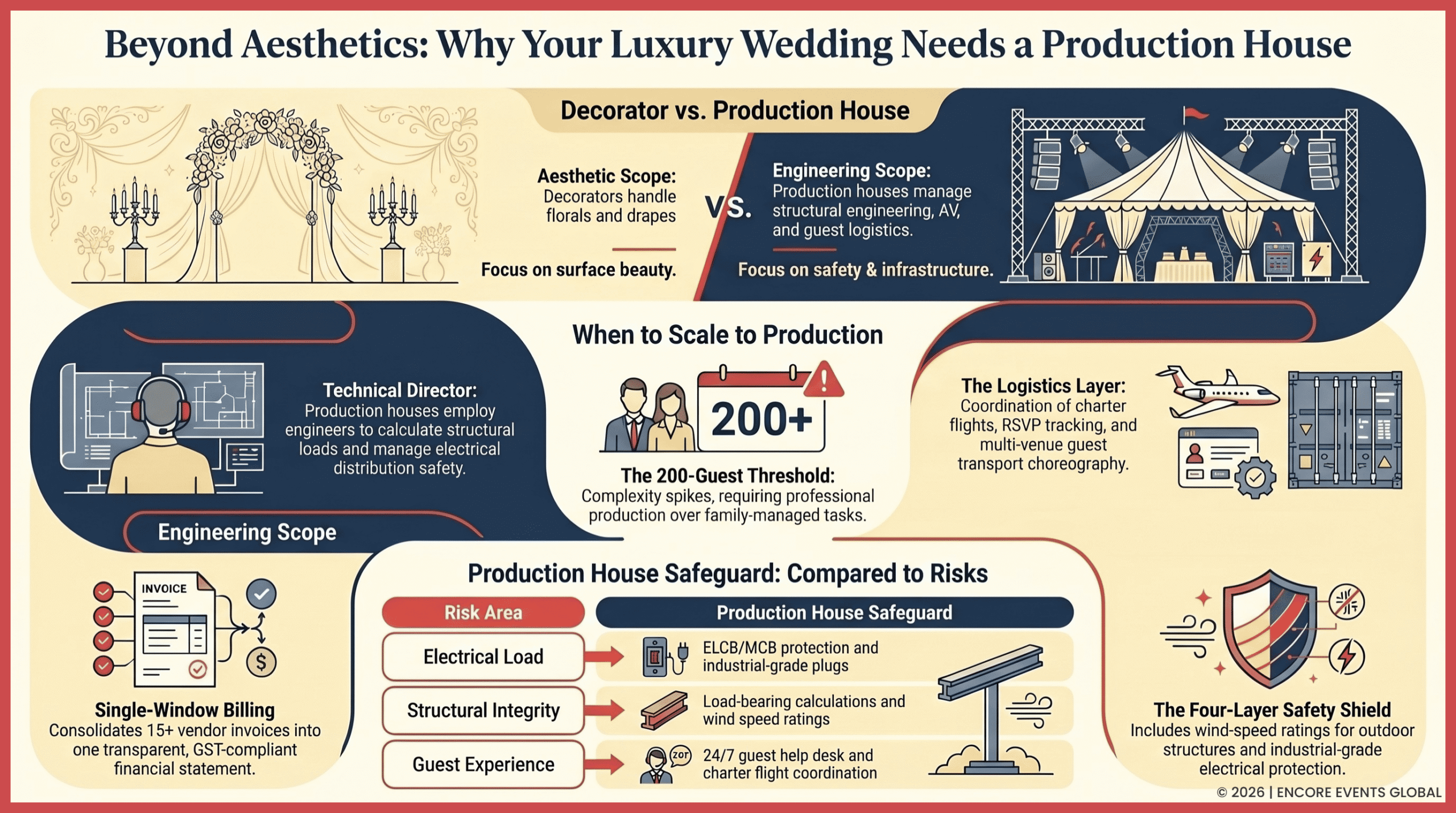
A decorator’s scope is, by definition, aesthetic. Florals, drapery, lighting design, table settings, and the visual identity of the mandap or stage. This is genuinely important work, and a skilled decorator can transform a venue dramatically.
A production house takes on everything a decorator does and layers it with structural engineering, AV and broadcast-grade technical execution, vendor coordination across a dozen specialised categories, end-to-end logistics for guest travel and accommodation, safety compliance, and a single point of financial and operational accountability for the entire event.
The practical difference shows up the moment something goes beyond pure aesthetics: rigging a 30-foot LED screen above a stage, calculating the wind load on an outdoor pandal structure, coordinating a 200-guest charter flight schedule, or managing the sound reinforcement for a sangeet performance with a live band and choreographed dance sequences. A decorator’s scope of work simply does not extend into these areas — and increasingly, modern Indian weddings require all of them.
Why This Distinction Matters at Scale
For an intimate 80-guest wedding at a single hotel banquet hall, a talented decorator working alongside the hotel’s own banquet team may be entirely sufficient. The complexity simply does not justify a production house engagement.
But the moment a wedding crosses certain thresholds — multiple venues, multiple days, 200+ guests, international travel, outdoor structures, or any form of technical production beyond basic lighting — the coordination demands exceed what a decoration-focused vendor is structured to handle. This is where families either end up managing a dozen separate vendor relationships themselves, or they hand that complexity to a single production partner with the operational capacity to manage it.
The families who choose the second path consistently report a dramatically less stressful planning experience — not because the wedding becomes simpler, but because the coordination burden shifts from the family to a dedicated team built for exactly this kind of complexity.
The Technical Director: A Wedding’s Unsung Hero
One of the most significant differences between a decoration agency and a production house is the presence of a dedicated Technical Director — a senior engineer who oversees the structural, electrical, and technical integrity of the entire event.
For a wedding involving outdoor structures, suspended decor elements, large-format LED screens, or elaborate lighting rigs, the Technical Director’s role includes reviewing structural load calculations for trussing and rigging, verifying CAD layouts against the actual venue dimensions, planning power load distribution across multiple zones, and effectively “”calling the show”” during live moments — the baraat entrance, the varmala, the first dance — to ensure every technical cue lands precisely on time.
This role does not exist in a traditional decoration agency’s structure, because decoration agencies are not typically staffed with engineers. It is, however, exactly the kind of oversight that prevents the structural and electrical failures that occasionally make headlines at large Indian weddings.
The Logistics Layer Most Families Never See
Behind every flawlessly executed destination wedding is a logistics operation that most guests never notice — which is exactly the point. Here is what that operation typically includes:
- Charter flight coordination: For weddings drawing guests from multiple cities or countries, coordinating charter flights or group flight bookings, managing manifest changes, and handling delegate communication is a dedicated logistics function in itself.
- RSVP and guest management: Tracking RSVPs, dietary preferences, room allocations, and special requirements across hundreds of guests requires a systematic process — not a spreadsheet maintained by a family member alongside their full-time job.
- 24/7 guest help desk: A dedicated, always-available point of contact for guest queries — lost luggage, transport changes, room issues, last-minute requests — removes an enormous operational burden from the hosting family during the event itself.
- Multi-venue transport choreography: When a wedding spans multiple properties across several days, the transport logistics for moving hundreds of guests between venues on tight schedules requires the same kind of planning discipline as a corporate conference.
None of this falls within a decorator’s scope of work. All of it falls squarely within a production house’s mandate.
Safety and Compliance: Why It Matters for a Wedding
It may seem unusual to discuss safety compliance in the context of a wedding, but large-scale weddings carry many of the same structural and electrical risks as corporate events — often with less rigorous oversight, because the industry default has historically prioritised aesthetics over engineering.
| Risk Area | What a Production House Checks |
|---|---|
| Electrical Load | Distribution boxes with ELCB/MCB protection, industrial plugs (no raw wire connections), double earthing for generators |
| Structural Integrity | Trussing load calculations, scaffolding leveling checks, wind speed ratings for outdoor mandaps and stages |
| Crew and Vendor Standards | Crew insurance, background checks for on-site personnel, full PPE compliance for technical staff |
| Heritage Property Risk | Load-bearing assessments before rigging on heritage architecture, cable management to avoid damage to historic structures |
A genuine production house treats these checks as standard operating procedure, not optional extras. A decoration-only vendor, in most cases, simply does not have the engineering capability to perform them.
The Billing Problem Nobody Talks About
A large destination wedding can easily involve fifteen to twenty separate vendors — decor, catering, AV, transport, hotel blocks, entertainment, photography, fireworks, and more. Each invoices separately, often with different payment schedules, different GST treatment, and different points of contact.
For the hosting family, this creates a reconciliation nightmare at exactly the moment they have the least bandwidth to manage it. A production house operating on a Single-Window Billing model consolidates all of this into one transparent, GST-compliant invoice — with no hidden vendor markups and a clear breakdown of where every rupee went.
This is not a minor convenience. For families managing wedding budgets that often run into crores, having a single point of financial accountability is a meaningful reduction in both administrative burden and financial risk.
Warning Signs You Are Working With a Decorator, Not a Production Partner
- No mention of structural calculations when discussing outdoor mandaps, stages, or suspended decor elements
- No dedicated logistics function for guest travel, RSVP tracking, or multi-venue transport coordination
- Multiple separate invoices expected from different vendors rather than one consolidated billing point
- No technical walkthrough scheduled before major rigging, AV, or lighting installation
- Limited in-house fabrication — heavy reliance on last-minute external rentals with no quality control process
None of these are necessarily disqualifying for a smaller, simpler wedding. But for a large, multi-day, multi-venue celebration, each one represents a meaningful gap in execution capability.
How to Choose the Right Production Partner
When evaluating wedding production partners for a large or complex celebration, ask direct questions that reveal operational depth rather than just aesthetic portfolio quality:
- Do you have an in-house Technical Director, or do you outsource technical oversight entirely?
- How do you manage guest logistics — charter flights, RSVP tracking, multi-venue transport?
- What does your billing structure look like — single invoice or multiple vendor invoices?
- What safety checks do you perform before installing rigging, stages, or electrical infrastructure?
- Do you have your own fabrication and warehousing capability, or do you rely entirely on third-party rentals?
The answers to these questions will tell you far more about a partner’s actual capability than their Instagram portfolio ever could.
How Encore Events Global Approaches Wedding Production
At Encore Events Global, we built our wedding division as an extension of our corporate production capability — not the other way around. The same Technical Directors who oversee structural safety at large corporate exhibitions apply the same rigour to wedding mandaps and stages. The same logistics team that manages international MICE delegations applies the same discipline to charter flights and guest help desks for destination weddings.
We own 20,000 square feet of warehousing across Mumbai and Delhi, along with an in-house fabrication unit, which means a significant portion of custom build elements — from mandap structures to branded stage sets — are constructed in-house under quality control, rather than outsourced at the last minute.
Every wedding is backed by our Single-Window Billing model and our Four-Layer Safety Shield, ensuring that the celebration your family has dreamed of is also one that is structurally sound, financially transparent, and logistically seamless.
If you are planning a destination wedding and want a partner who treats it with the same operational rigour as a major corporate production, connect with our team for an initial consultation.
Frequently Asked Questions
What is the difference between a wedding decorator and a wedding production house?
A decorator focuses on aesthetics — florals, drapery, and lighting design. A production house manages the full scope of a large wedding including structural engineering, technical AV execution, guest logistics, safety compliance, and consolidated billing across all vendors.
At what wedding size does a production house become necessary?
Weddings with 200+ guests, multiple venues, multi-day formats, outdoor structures, significant technical production (large LED screens, complex lighting, projection mapping), or international guest travel typically exceed the operational capacity of a decoration-only vendor.
Why does a wedding need a Technical Director?
A Technical Director reviews structural calculations for rigging and stages, verifies electrical load distribution, and oversees live technical execution during key moments. This engineering oversight prevents structural and electrical risks that decoration-focused vendors are typically not equipped to assess.
What is Single-Window Billing for weddings?
Single-Window Billing consolidates payments to all wedding vendors — decor, catering, AV, transport, entertainment — into one transparent, GST-compliant invoice from the production house, eliminating the need to reconcile fifteen to twenty separate vendor bills.
How does Encore Events Global manage destination wedding logistics?
Encore manages charter flight coordination, RSVP and guest tracking, 24/7 guest help desks, and multi-venue transport choreography as standard components of its wedding production service, backed by in-house fabrication, warehousing, and a dedicated Technical Director for every event.
Conclusion
The beauty of a wedding will always start with the decor — the florals, the lighting, the visual story of the day. But for large, ambitious celebrations, beauty alone is no longer the whole job. The structural integrity of the stage, the safety of the electrical systems, the comfort of guests travelling from across the world, and the financial clarity of the billing all matter just as much, even though they are invisible when done well.
Choosing a production house over a decorator is not about spending more. It is about matching the complexity of your celebration with a partner genuinely built to handle it.
Talk to Encore Events Global about bringing production-grade rigour to your destination wedding.